Many lesbian couples would like to have a child together.
For many female couples, the wish to start a family is a significant step. The path to it is often associated with specific questions—not only medical, but also legal and organisational. Many couples are facing topics such as sperm donation, treatment options or legal requirements for the first time and would like clear guidance.
We support you from the outset with clear information on key topics.
Typical questions and uncertainties
- What legal requirements apply to us as a couple?
- Do we have to be married to start treatment?
- How does treatment with donor sperm work?
- Where does the donor sperm come from and how is it selected?
- What options do we have to become pregnant?
- Which of us will carry the pregnancy?
- Who covers the costs of treatment?
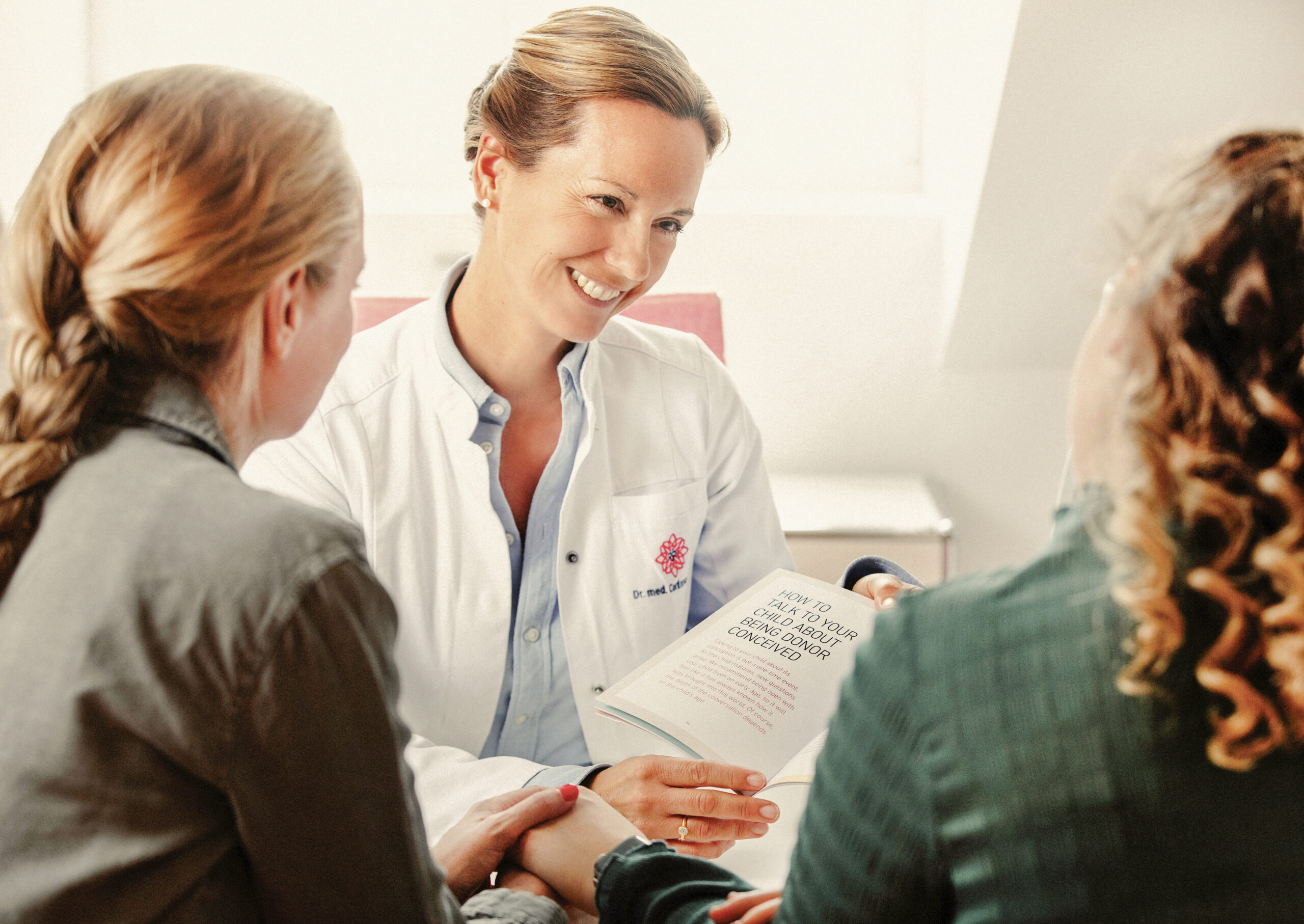


Treatment options for lesbian couples
Every fertility treatment starts with an individual decision. Together, we will find the treatment that best fits your personal situation, your medical requirements and your wishes.
If you have an irregular cycle, or if we would like to support ovulation in a targeted way, hormonal treatment can make sense. It helps determine the optimal time for insemination and tailor the treatment to you.
Insemination (IUI) is often the first treatment step for lesbian couples. Prepared donor sperm is inserted directly into the uterus at the time of ovulation using a fine catheter. The treatment is gentle, takes only a few minutes and can be performed without anaesthesia.
IVF or ICSI treatment can make sense if insemination is not medically suitable or has not led to success after several treatment cycles. For women from around the age of 40, or with certain medical requirements, IVF may in some cases be the more promising first treatment option right away. Eggs are retrieved, fertilised in the laboratory and then transferred into the uterus as an embryo.
If you wish, we can complement medical treatment with nutritional counselling, psychological support and naturopathic approaches. Together, we will discuss which supportive measures may be appropriate in your personal situation.
This is how fertility treatment for lesbian couples works
At the fertility centre Die Kinderwunschärztin in Munich, we support you step by step on your path to your desired child—individually, transparently and with extensive experience. Together, we develop a treatment plan that fits your personal situation and your wishes.
-
Personal initial consultation
At the beginning, we take the time to get to know you as a couple and understand your personal situation. Together, we discuss your medical history, your wish to have a child and your individual wishes, and we answer all questions you may have about the treatment. Of course, we involve both partners equally in counselling and planning.
Make an appointmentIn addition to an initial gynaecological examination with ultrasound and—if appropriate—hormone testing, we provide detailed information about the different treatment options with donor sperm. We also explain the organisational process, the next steps, legal specifics, as well as selecting a suitable sperm donor and the right sperm bank.
An important part of the initial consultation is also considering together which treatment offers the best chances of success for your personal situation. This gives you clarity about the next steps from the outset, so you can start your fertility treatment well informed and with a secure feeling.
-
Individual Diagnostics
Before we begin treatment, we would like to understand your individual requirements in detail. Depending on your personal situation, this includes cycle and hormone diagnostics and, if insemination is planned, checking tubal patency.
Which additional examinations are appropriate depends on your age, your medical history and any pre-existing conditions. Based on all findings, we can decide together which treatment offers the best chances of success for you and create an individual treatment plan.
-
Joint treatment planning
Once all examination results are available, we will discuss them with you in detail. Together, we will decide which treatment offers the best chances of success for your personal situation – be it insemination with donor sperm or IVF/ICSI treatment.
If hormonal support is appropriate, we explain the different options and create an individual treatment plan. We take into account not only the medical requirements, but also your personal wishes and the organisational process, so that you know exactly what the next steps will look like.
-
Your treatment with insemination or IVF/ICSI
If the medical conditions are favorable, we usually start with insemination (IUI) with donor sperm. The prepared sperm are introduced directly into the uterus at the optimal time using a fine catheter. The treatment is gentle, takes only a few minutes, and can be performed without anesthesia.
If insemination is not medically appropriate or does not lead to success after several treatment cycles, we will discuss together whether IVF or ICSI offers better chances of success. Which treatment is right for you is always decided individually—based on your medical requirements and your personal wishes.
-
Personal support until the first fetal heartbeat
We are also happy to continue supporting you after successful treatment. With regular check-ups, we will care for you during the first weeks of pregnancy and look forward to seeing your child’s first heartbeat together with you on the ultrasound.
Many of our patients remain in our care up to this point. Of course, you can continue further pregnancy care—e.g. if you have a longer journey or at your own request—at any time with your gynaecologist.
It is important to us that you feel well supported throughout your entire fertility treatment. That is why we are also happy to remain available as your point of contact during the first weeks of your pregnancy.
The right treatment for your individual situation
The chances of success of fertility treatment depend on various factors—especially age, ovarian reserve, your individual medical situation and the chosen treatment method. That is why we develop a personal treatment plan for each patient, based on your requirements and your wish to have a child.
In many cases, we start with insemination (IUI) with donor sperm, as it is a simple, gentle and low-burden treatment. The chances of pregnancy per treatment cycle depend strongly on age. In younger women between their mid-20s and early 30s, they can reach around 25 to 30% per cycle with good requirements, while in women around the age of 40 they can drop to around 5% per treatment cycle.
We decide together with you how many insemination cycles make sense. Often—depending on age and individual situation—three to six treatment cycles are carried out before we assess whether IVF treatment could offer better chances of success. Especially for women from their mid to late 30s, it can make sense to consider IVF earlier so as not to lose valuable time.
If insemination is not medically possible or not promising, or if pregnancy has not occurred after several treatment cycles, IVF or ICSI may be the appropriate treatment. The chances of pregnancy per treatment cycle are generally significantly higher than with insemination, but they also decrease with increasing age. For women in their early 30s, they are around 30 to 40%, between 35 and 39 years around 25 to 35%, and at age 40 around 15 to 25% per treatment cycle.
In a personal consultation, we take the time to discuss your individual situation in detail, classify your chances of success realistically, and develop a treatment strategy together with you that is medically appropriate and fits your personal wishes.
Sperm donation for lesbian couples
Donor sperm is required for fertility treatment in lesbian couples. Most of our patients choose sperm donation via a licensed sperm bank. We support you from selecting a suitable donor through to ordering and storing the sperm sample, and we provide advice throughout the entire process.
Some couples would like sperm donation from someone they know—for example, a friend or acquaintance. In principle, this route can also be possible, and we will be happy to support you in carefully reviewing the different options.
Compared to sperm donation through a sperm bank, however, private sperm donation involves several additional medical, legal, and organizational aspects to consider. These include, among other things, necessary medical examinations, the legal situation of all parties involved, and questions about the later role of the donor and the rights of the child.
If you are considering private sperm donation, we take time for your questions and discuss together with you what prerequisites should be met and what next steps make sense. If needed, we also recommend experienced contacts for the necessary legal advice.
Collaboration with a licensed sperm bank offers a high degree of medical and legal security. Sperm donors are carefully examined according to legal requirements. At the same time, the required data is documented so that the child born later can receive information about his or her genetic origin in accordance with legal regulations.
We work with selected renowned national and international sperm banks—including Cryos International, the European Sperm Bank, and other selected sperm banks. We are happy to support you in finding the right donor and accompany you through all organizational steps—from selection and ordering to storage of the sperm sample in our cryo storage. This way, you can focus entirely on your desire for a child.
Legal questions? We support you step by step
If you decide as a female couple to undergo fertility treatment with donor sperm, legal questions arise in addition to medical ones. This is completely normal—and it is exactly where we support you step by step.
Under the current legal situation in Germany, the woman who gives birth to the child is initially the legal parent. The wife or partner does not automatically also become a legal parent. To ensure that you and your future child are protected as well as possible, stepchild adoption is generally required after the birth.
So that you have clarity from the outset, we recommend family-law counselling even before treatment begins. We will be happy to provide you with experienced contacts and explain which documents are required.
The counselling covers topics such as parenthood, custody, maintenance, inheritance law, advance planning, and the legal status of the sperm donor. This allows you to approach starting your family well prepared from the very beginning.
Of course, we also inform you about the legal regulations relating to sperm donation. With treatment using a licensed sperm bank, the sperm donor’s data is documented in the statutory sperm donor register. Your child later has the right to learn about their genetic origin—an important part of transparent and responsible family planning. In a personal consultation, we take the time to answer all your questions and guide you step by step through the medical, organisational and legal processes—so that you can focus fully on your wish to have a child.

Why lesbian couples come to us
Clear guidance, structured processes and treatment tailored to you as a couple.
Make an appointment-
Clear perspective
From the outset, we provide a realistic assessment of your chances of success and develop a clear treatment plan together with you.
-
Consistent care
You will be cared for throughout by the same doctor, who knows your medical history and coordinates your treatment step by step for both of you.
-
A calm and personal environment
We create a setting in which you can speak openly, ask questions and make decisions at your own pace—without pressure.
-
Holistic view
In addition to medical treatment, we also consider other aspects such as nutrition or mental strain when needed.

What Our Patients Say


Frequently asked questions about fertility treatment for lesbian couples
How can lesbian couples become pregnant?
In many cases, we start with insemination (IUI). Depending on age, medical requirements and your personal chances of success, IVF or ICSI may also be the more appropriate treatment from the outset. We discuss which method is suitable for you together after comprehensive diagnostics.
Where does the donor sperm come from?
For treatment, we use donor sperm from recognised sperm banks that meet strict medical and legal requirements. Donors are comprehensively screened, including for genetic and chronic conditions as well as transmissible infections.
This ensures that both medical and legal standards are met. If you wish, we will advise you in detail on the selection process and the different options.
We work with selected national and international sperm banks and are happy to support you in choosing a suitable donor.
When is IVF appropriate?
IVF or ICSI treatment can make sense if it offers better chances of success compared to insemination. There can be various reasons for this.
Typical situations in which we are more likely to recommend IVF include, for example:
- Blocked or reduced tubal patency
(then insemination is often not promising) - Several unsuccessful inseminations
Often—depending on age—3 to 6 IUI cycles are common before considering IVF. - Age and chances of success
As pregnancy rates decline with increasing age, IVF may become appropriate sooner at advanced age in order to gain time. - Individual medical factors
e.g. abnormalities in hormone levels, reduced ovarian reserve or other findings from diagnostics
In the initial consultation and after diagnostics, we create a realistic, individual treatment plan together with you.
Do we have to be married to start treatment?
No. You do not have to be married to start fertility treatment with donor sperm. However, before treatment, some legal questions should be clarified—especially with regard to joint parenthood. We are happy to support you with this and, if needed, recommend experienced contacts for the necessary legal counselling.
How is legal parenthood regulated for lesbian couples?
After the birth, the woman who gives birth to the child is initially the legal mother. Under current law, the second mother does not automatically become a legal parent—even if you are married. As a rule, legal parenthood is established through stepchild adoption after the birth. We will be happy to explain which steps are necessary in your personal situation during a consultation and, if needed, recommend specialised legal counselling.
What costs arise for fertility treatment for lesbian couples?
The costs depend on the chosen treatment method. Insemination with donor sperm at our centre is usually between €470 and €540 (incl. VAT) per attempt—excluding the required appointments for cycle monitoring and hormone checks. The number of appointments, and therefore the costs, can vary. Typically, one to three appointments at €180 to €200 each (incl. VAT) are required.
IVF is significantly more complex and generally costs around €3,800 to €4,300 (incl. VAT) per cycle. In special cases, ICSI may be required, which results in additional costs. In addition, there are expenses for donor sperm, anaesthesia, external laboratory services, medication and, if applicable, additional treatments.
Before treatment begins, you will receive a transparent cost plan so that you can assess all costs incurred from the outset.
Does health insurance cover the costs of fertility treatment?
For same-sex female couples, statutory health insurance in Germany does not cover the costs of fertility treatment. Diagnostics as well as insemination, IVF or ICSI therefore have to be financed privately. Before treatment begins, we provide a transparent cost plan so that you can understand all items and make a well-informed decision.
Up to what age is fertility treatment possible?
Legally, there is no fixed age limit for fertility treatment in Germany. Medically, however, the chances of success depend significantly on age and individual requirements. As a rule, the earlier treatment begins, the higher the chances of pregnancy.
With insemination (IUI) using donor sperm, the chances of pregnancy per treatment cycle are often 25 to 30% for women up to around age 34, usually 10 to 15% between 35 and 39 years, and around 5% from age 40.
With IVF or ICSI treatment, the chances of success are higher. They are often 30 to 40% for women up to around age 34, 25 to 35% between 35 and 39 years, and around 15 to 25% per treatment cycle from age 40. You will find a clear overview of average chances of success by age and treatment method further up on this page. In a personal consultation, we explain how these values can be applied to your individual situation and which treatment offers the best chances of success for you.
Which of us will become pregnant?
In most cases, it is already clear before the first consultation which partner would like to carry the pregnancy. If you have not yet decided, we will be happy to advise you and discuss together which medical requirements play a role for each of you.
We take into account, among other things, age, ovarian reserve, the cycle and any pre-existing conditions. This way, together we find the treatment path that offers the best chances of success and fits your personal situation.