What does Social & Medical Freezing mean?
Perhaps a child does not quite fit into your life right now – but you would like to keep the possibility of a family open for later. Or a medical treatment is imminent that could impair your fertility.
By freezing eggs or sperm, you can take precautions today for a possible desire to have children in the future. If this is done for personal reasons, it is referred to as social freezing. If, on the other hand, an illness or medical treatment that could impair fertility is the primary concern, it is called medical freezing. Which form of fertility precaution makes sense for you and when the right time for it might be depends on your personal situation. This is exactly what we will discuss together with you.
When can cryopreservation be useful?
- If you would like to postpone your desire for children until later: Eggs or sperm can be frozen at a younger age and stored for later fertility treatment.
- If you would like to preserve your fertility as a precaution due to your age: Especially in women, the number and quality of eggs decrease with increasing age. The suitable time for social freezing should therefore be assessed individually.
- Before a medical treatment that could damage fertility: for example, before chemotherapy, radiation therapy, or certain drug therapies.
- In the case of illnesses or planned operations that can impair fertility: for example, in the case of endometriosis or before certain procedures on the ovaries.
- As part of IVF or ICSI treatment: Fertilized eggs can be frozen for a later transfer. This can make further treatment possible without renewed hormonal stimulation and egg retrieval.
- To preserve male fertility: for example, if there is a later desire for children, before a vasectomy, or before a medical treatment that could impair sperm production.
Who is cryopreservation suitable for?
 Couples with a desire for children
If fertilized eggs are produced during IVF or ICSI treatment that are not used further in the current treatment cycle, these can be cryopreserved for later treatment. This can make a further transfer possible at a later date without the need for renewed hormonal stimulation and egg retrieval – for example, if there is a later desire for a sibling.
Women who want to preserve their fertility for later
Perhaps the right time for a child has not yet come or the right partner is missing. With social freezing, you can have unfertilized eggs frozen and thus maintain an additional option for a later desire to have children.
Men who want to take precautions for later
For men who want to have sperm frozen to preserve their fertility and take precautions for later family planning.
Patients before medical therapies
If an illness or upcoming therapy could impair your fertility, eggs or sperm can be frozen as a precaution. Especially before chemotherapy or radiation therapy, it is important to address the issue before the start of treatment if possible.
What you should know about cryopreservation
- A later pregnancy cannot be guaranteed.
- Side effects can occur during hormonal stimulation.
- Egg retrieval is a medical procedure. As with any procedure, there are minor risks, for example, for bleeding, infections, or complications in connection with the anesthesia.
- Not every frozen egg or all sperm survive the freezing and thawing process.
- Legal requirements apply to cryopreservation and later use.

Cryopreservation Process
How cryopreservation works depends on whether you want to freeze eggs or sperm, or whether fertilized eggs from a fertility treatment are being cryopreserved. We plan your treatment individually and with clear, carefully coordinated steps. From the first consultation to storage, the entire process is coordinated by us – personally, structured, and with fixed contact persons.
-
Consultation & Diagnostics
Make an appointmentIt starts with a personal, in-depth consultation. We discuss why you would like to preserve your fertility, which options are suitable for you, and what timing makes sense.
Depending on the situation, this includes different examinations – for women, for example, ultrasound and hormone analyses, for men, a spermiogram.
On this basis, we can plan the further procedure with you individually and with medical care.
-
Retrieval of Eggs or Sperm
Depending on the method and your starting situation, the individual steps differ in how they proceed.
For the freezing of eggs, the ovaries are first hormonally stimulated for a few days. The mature eggs are then retrieved during a short puncture under anesthesia.
For the freezing of sperm, you provide a semen sample. A separate, quiet room with plenty of privacy is available for this purpose at our center. If you live nearby, the sample can also be obtained at home by prior arrangement and brought to us within the agreed time window. It is then examined, processed, and prepared for cryopreservation directly in our own laboratory. If no sperm can be detected in the ejaculate, surgical sperm retrieval from the testicular tissue (TESE) may be considered in certain situations.
As part of IVF or ICSI treatment, fertilized eggs that are not used further in the current treatment cycle can be cryopreserved for later treatment.
-
Freezing & Storage
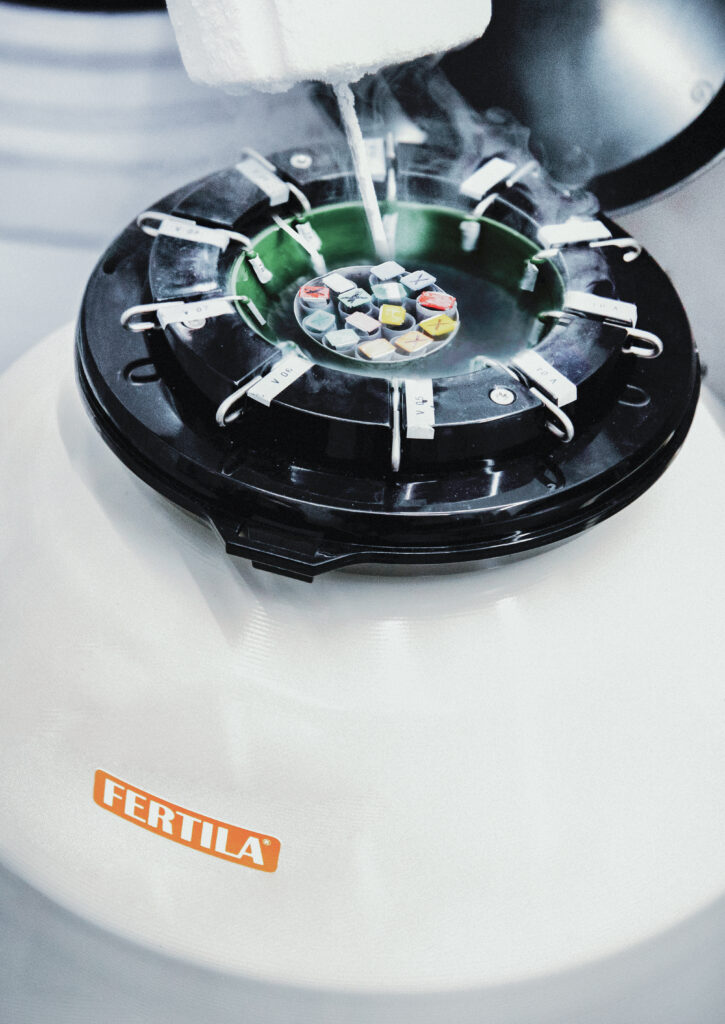
After processing, eggs, sperm, or fertilized eggs are gently frozen using the most suitable cryopreservation method in each case. The samples are then stored at around −196°C in liquid nitrogen in our own cryostorage facility.
At these low temperatures, the biological processes of the cells practically come to a standstill. The storage conditions are continuously monitored and the samples are clearly documented and assigned. In this way, your eggs, sperm, or fertilized eggs can be stored long-term for later fertility treatment.

Cryopreservation in Munich: Why Choose Us?
Anyone who has eggs or sperm frozen for the future is making a very personal decision. It is important to us that you feel well-advised medically and that the entire process is organized for you in a clear, reliable, and uncomplicated manner.
Make an appointment-
Personal Consultation
We take time for your individual situation and your family planning. Together we discuss which form of fertility precaution makes sense for you and plan your treatment individually – medically sound and according to current scientific standards.
-
Everything Carefully Coordinated
From the first consultation and diagnostics through treatment to cryopreservation and long-term storage, the individual steps are clearly coordinated with us. You know at all times how things will proceed and have fixed contact persons.
-
Own Laboratory & Cryo-storage
Your eggs or sperm are processed and cryopreserved directly at our facility. Long-term storage takes place in our own cryo-storage on site – under continuously monitored conditions.
-
Discretion & Privacy
Our center offers you a quiet, private atmosphere. A separate room is also available for providing a semen sample, where you will be undisturbed.
-
Certified Quality & Safety
Our laboratory and cryo-area are subject to official requirements and controls. In addition, we ensure our quality through regular internal and external quality controls as well as participation in proficiency tests. In this way, we continuously check our laboratory standards and ensure reliable processes for cryopreservation and storage.
-
Flexible Appointments
With long opening hours and structured appointment planning, we try to integrate your treatment into your everyday life as well as possible – including appointments in the early morning or in the evening.
-
In the Heart of Munich
Our fertility center is located in the heart of Munich and is easily accessible by public transport and by car.

What Our Patients Say

Freezing eggs, sperm, and fertilized eggs: How much are the costs?
The costs depend on what is being frozen and what treatment is required for it. When freezing eggs, for example, costs arise for hormonal stimulation, egg retrieval, and cryopreservation. For sperm, the effort is significantly lower.
So that you know what to expect from the start, we will discuss the expected costs transparently with you before the start of treatment.
The costs include hormonal stimulation, egg retrieval, and the processing and vitrification of the retrieved eggs.
In addition, costs for medication, anesthesia, external laboratory services, and long-term storage may arise.
Storage currently costs approx. €380 per year.
Make an appointmentFor the subsequent storage, we charge:
- €38 per month for monthly billing
- €380 per year for annual billing
For a new storage, an additional processing fee applies
- of €75 for a sample obtained in our center
- or €150 for externally delivered samples.
No fixed or flat-rate prices: We bill on the basis of the official scale of fees for doctors (GOÄ). According to the GOÄ, we are not allowed to quote fixed or flat-rate prices for medical services. The prices mentioned are intended to provide orientation and are typical for the treatments mentioned.
Possible VAT liability: Medical services may be subject to VAT (currently 19%). This applies if, after diagnostics have been carried out, no medical indication or confirmed diagnosis is present and it is therefore not a medical treatment in the strict sense. This can be the case in particular with social freezing treatments, but also with the treatment of single moms and same-sex couples.
If you have eggs or sperm frozen as a precaution for personal reasons, social freezing is usually a self-payer service.
In the case of a medical indication, cost coverage may be possible. Privately insured persons should clarify before the start of treatment which services their individual tariff covers.
For those with statutory insurance, there is a claim to cost coverage under certain conditions if a germ cell-damaging treatment is imminent due to an illness. The statutory regulation generally provides for this claim for women before the age of 40 and men before the age of 50.
Since we are a private fertility center, we cannot bill these services through statutory health insurance. Tip: Some employers now contribute to the costs of social freezing as part of fertility or employee benefits. It may therefore be worth checking your employer’s benefits.

Frequently Asked Questions about Cryopreservation
When is the best time to have eggs or sperm frozen?
The right time depends on both biological and personal factors:
- Eggs: With increasing age, the number and quality of eggs decrease, usually more significantly from the early to mid-30s. For social freezing, the following generally applies: The younger a woman is when her eggs are frozen, the more favorable the biological conditions for later use usually are. Whether and when social freezing makes personal sense, however, always depends on the individual situation and family planning.
- Sperm: Male fertility usually remains intact for longer, but sperm quality can also change with increasing age. In addition, certain genetic changes in the sperm increase with paternal age. Early cryopreservation can therefore be useful if the desire for children is planned much later – and especially before a medical treatment that could impair fertility, such as chemotherapy.
Which time makes sense for you personally depends on your age, your health situation, and your life and family plans. In a personal conversation, we can assess your individual starting situation and discuss together when cryopreservation can be useful for you.
What is the difference between social freezing and medical cryopreservation?
In social freezing, eggs or sperm are frozen as a precaution for personal reasons in order to preserve one’s own fertility for later family planning. A medical indication usually does not exist.
In medical freezing, cryopreservation takes place for medical reasons – for example, before chemotherapy, radiation therapy, or another treatment that could impair fertility. Freezing eggs or sperm before the start of treatment can help preserve the chance of a later desire for children.
How long can I store my eggs or sperm?
Eggs and sperm can be cryopreserved over very long periods of time. When stored in liquid nitrogen at about −196 °C, biological processes come to an almost complete standstill. The frozen eggs or sperm do not age biologically any further during this time.
According to current scientific knowledge, there is therefore no fixed biological maximum duration for cryo-storage. The decisive factor for later use is primarily the quality of the eggs or sperm at the time of freezing – and not how many years they were subsequently stored.
Is cryopreservation paid for by health insurance?
In social freezing, cryopreservation is usually a self-payer service. In the case of a medical indication, such as before a germ cell-damaging treatment, cost coverage by health insurance may be possible. Since we are a private center, we cannot bill through statutory health insurance. Privately insured persons should clarify possible cost coverage with their insurance in advance.
A look at your employer’s benefits can also be worthwhile: some companies contribute to the costs of social freezing as part of so-called fertility benefits.
What should I clarify before freezing eggs or sperm?
Before cryopreservation, you should know what possibilities freezing offers for your later family planning, what costs arise, and how long-term storage is regulated. The medical requirements and the realistic chances of later use also play an important role.
We will discuss which points are personally relevant for you in advance and clarify all medical and organizational questions.
What legal requirements apply to cryopreservation in Germany?
The freezing and storage of unfertilized eggs and sperm for fertility precautions is generally possible in Germany. For fertilized eggs and embryos, additional legal requirements apply, in particular according to the Embryo Protection Act.
We will explain which regulations are relevant for your personal situation as part of the consultation and information before cryopreservation.
What is FertiPROTEKT?
FertiPROTEKT is a network of specialized centers for fertility preservation in the case of medical illnesses and treatments. Patients for whom, for example, chemo, radiation, or another potentially fertility-damaging therapy is planned, can receive advice there according to current medical recommendations. Depending on the personal situation, different options are possible, such as freezing eggs, sperm, or ovarian tissue.