Semen analysis to assess male fertility
A semen analysis is the most important basic test for assessing male fertility. It examines, among other things, sperm concentration, motility and shape (morphology), as well as various properties of the ejaculate. The results provide important indications of sperm quality and how favourable the conditions are for natural fertilisation.
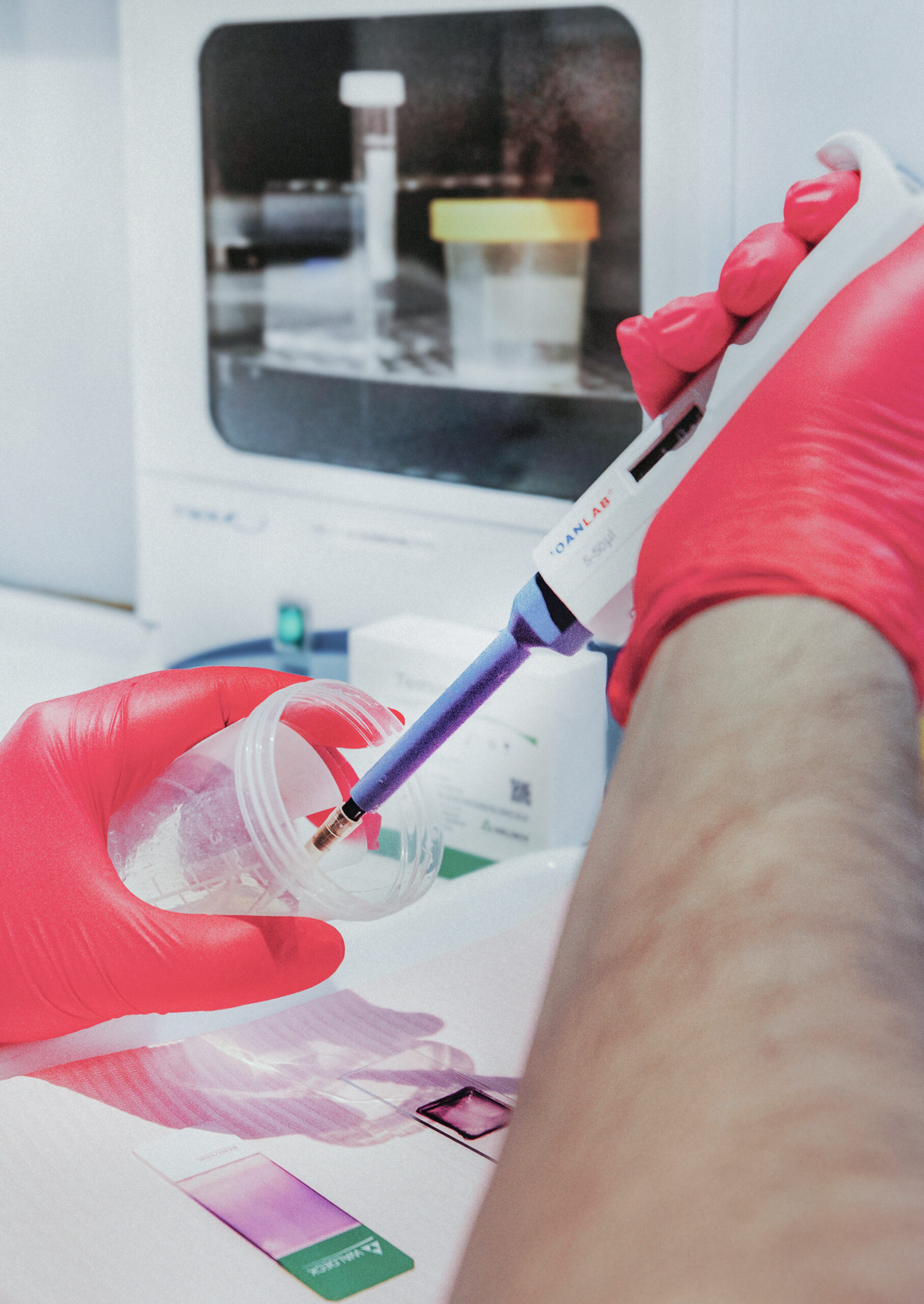
At the private centre Die Kinderwunschärztin in Munich, the semen sample is examined directly in our in-house andrology laboratory according to current WHO criteria. The findings are then reviewed by a specialist and explained clearly. Depending on your personal situation, the sample can be collected discreetly either at our practice or at home.
-
Fertility test at our centre
If you would like to have your semen analysis carried out directly with us, you can provide the semen sample discreetly and in a protected atmosphere at our private centre. The sample is then examined immediately in our in-house andrology laboratory and evaluated by a specialist.
-
At-Home Fertility Test
If you would prefer to collect the semen sample in your familiar surroundings, this is also possible at home. You then bring the sample to us at the agreed appointment, where it is examined promptly in our in-house andrology laboratory and evaluated by a specialist. This allows the semen analysis to be integrated into your daily routine flexibly and easily.
When a semen analysis is useful
A semen analysis may be useful if you would like to better assess your fertility or learn more about your current sperm quality. Especially in cases of an unfulfilled desire to have a child, the test provides important indications as to whether sperm quality could be a factor and helps you plan possible next steps in a targeted way.
Who a semen analysis is suitable for
 Men with an unfulfilled desire to have a child
If pregnancy does not occur, a semen analysis provides important indications as to whether sperm quality could play a role. Male factors are often involved in an unfulfilled desire to have a child: in around one third of couples, significant causes are found on the man’s side. However, it is not uncommon for several factors to come together, meaning that possible causes of an unfulfilled desire to have a child may exist for both the woman and the man.
Men before fertility treatment
Before insemination or artificial fertilisation, a semen analysis is a key component of basic diagnostics.
Men for preventive clarification
Even without a current desire to have a child, a semen analysis can help you assess your fertility realistically and plan ahead early.
Men with known pre-existing conditions
A semen analysis may be useful if known pre-existing conditions are present, such as undescended testicles in childhood, varicose veins in the testicle (varicocele), hormonal disorders, diabetes, previous infections or surgery in the intimate area, as these can impair sperm quality.
Men for follow-up of an abnormal semen analysis
As sperm quality is subject to natural fluctuations, an abnormal semen analysis should be checked with a second test. This makes it easier to assess whether the changes persist and whether further diagnostics or treatment are advisable.

Interpretation of semen analysis results
Gold standard
A semen analysis is considered the central basic test for assessing male fertility and serves as medical guidance for the next steps. The results show whether the parameters examined are within the age-appropriate reference range or whether there are indications of reduced ability to conceive—for example due to reduced motility or abnormalities in sperm shape.
Because sperm quality is subject to natural fluctuations and sperm are continuously produced, a single semen analysis is always a snapshot. Temporary influences such as infections, fever, stress or other strains can also affect the values. If the findings are abnormal, we therefore generally recommend a repeat test after a few weeks—often after about six weeks. This allows us to assess whether the changes are confirmed or whether sperm quality differs at the follow-up test.
Which further tests or treatments are advisable depends on the semen analysis result, your personal medical history and—if you wish to have a child—also on your partner’s situation. Not every abnormal finding automatically requires treatment.
Further diagnostics
If the semen analysis is very abnormal, further urological-andrological assessment should be carried out. Depending on the findings, an andrological examination, hormone tests, an ultrasound of the testicles or, in certain situations, genetic tests may be recommended.
A DNA fragmentation test is an additional examination of sperm quality. While the classic semen analysis primarily assesses the number, motility and shape of the sperm, the DNA fragmentation test examines the quality of the genetic material contained in the sperm. It determines the proportion of sperm with damage or breaks in the DNA.
The test may be particularly useful if pregnancy does not occur despite a largely unremarkable semen analysis, sperm morphology is significantly impaired, recurrent miscarriages have occurred, or several fertility treatments have been unsuccessful. The result can provide additional indications and help plan further diagnostics and treatment more precisely.
In selected situations, special tests such as the HBA test or the CatSper test can provide additional information about sperm maturity and function. We will discuss individually whether such additional diagnostics are useful, based on the semen analysis and your fertility history to date.
Treatment of possible causes
Depending on the cause, treatable factors such as hormonal disorders, infections or certain changes in the testicle, such as varicoceles (varicose veins), can be further investigated and treated if necessary.
If fertility is reduced, artificial fertilisation may be a suitable option for fulfilling a desire to have a child. The sperm are prepared in a targeted way and—depending on the method—brought together with the egg either in the body or in the laboratory.
If no sperm or only very few sperm can be detected in the ejaculate, direct retrieval of sperm from testicular tissue may be possible in certain situations. In the procedure known as TESE (testicular sperm extraction), testicular tissue is removed in a minor surgical procedure and then examined in the laboratory specifically for sperm.
Retrieved sperm can be frozen and later used to fertilise eggs as part of an ICSI treatment. Whether TESE is advisable and how high the individual chances are depends on the cause of the abnormal semen analysis and is carefully clarified in advance.
In cryopreservation, sperm are gently frozen and stored long-term at very low temperatures. This preserves current sperm quality—especially if further deterioration is expected or treatment is planned for a later date.
Procedure for the semen analysis
At the private center Die Kinderwunschärztin in Munich, we accompany you step by step – individually, transparently, and with the utmost care.
-
Select & Start Test
You choose the appropriate fertility test – either for home use or for performance at our private center in Munich – and then answer a few short questions online about your situation.
Make an appointment -
Sample Collection
The semen sample can be collected discreetly either in our men’s room or at home.
If the sample is collected at home, we will provide you with a suitable container in advance. Before collecting the sample, please follow the guidance on the recommended period of abstinence in your appointment confirmation. At the agreed appointment, bring the sample to our fertility centre, transported close to the body, within a maximum of 40 minutes after collection.
-
Analysis & Results
The sample is analyzed immediately in our in-house andrology laboratory. You will usually receive the medically reviewed findings encrypted by email within less than three working days.
-
Further Procedure
Should the results be outside the normal range, we recommend repeating the spermiogram after a few weeks to verify the results and enable a reliable assessment. Based on this, we will decide together with you which next steps are appropriate.

-
Medically reviewed findings
Every semen analysis is personally reviewed and medically interpreted by an experienced fertility specialist before you receive the results report.
-
Clear & easy to understand
The results are presented clearly, compared with reference values and explained in an understandable way—for a realistic assessment of your sperm quality.
-
Flexible testing options
You can have the semen analysis carried out on site at our private centre in Munich or collect the sample at home.
-
Prompt results
You will receive your encrypted results report within a few days, giving you clarity about your fertility quickly.

What Our Patients Say

Costs for a semen analysis in Munich
The cost of a semen analysis varies depending on whether you choose to have it carried out on site at our private centre in Munich or flexibly at home. Both options provide you with a reliable medical evaluation according to current WHO criteria.
At our private centre Die Kinderwunschärztin in Munich, you will receive a specialist-reviewed analysis according to current WHO criteria.
To the cost overviewThe sample is collected at our private centre in Munich in a calm, protected atmosphere. You benefit from direct medical support on site.
The subsequent analysis is carried out in our andrology laboratory and evaluated by a physician. You will usually receive the findings encrypted by email within around five days.
Book an appointmentYou collect the semen sample discreetly at home and then bring it to us within a maximum of 40 minutes. This allows the test to be integrated into your daily routine flexibly.
We will provide you with a suitable container in advance and inform you about the procedure. The analysis is carried out in our andrology laboratory and evaluated by a physician. You will usually receive the findings encrypted by email within fewer than three working days.
Book an appointment to drop off your sampleNo fixed or flat-rate prices: We bill on the basis of the official scale of fees for doctors (GOÄ). According to the GOÄ, we are not allowed to quote fixed or flat-rate prices for medical services. The prices mentioned are intended to provide orientation and are typical for the treatments mentioned.
Possible VAT liability: Medical services may be subject to VAT (currently 19%). This applies if, after diagnostics have been carried out, no medical indication or confirmed diagnosis is present and it is therefore not a medical treatment in the strict sense. This can be the case in particular with social freezing treatments, but also with the treatment of single moms and same-sex couples.
We would be happy to provide you with detailed cost information for the planned treatment in advance. This allows you to clarify cost coverage with your private health insurance (PKV) as best as possible beforehand. Statutory health insurance (GKV) does not cover costs at our center.

Frequently asked questions about semen analysis
How often is the man the reason when a desire to have a child is not fulfilled?
If pregnancy does not occur despite regular unprotected intercourse, the cause is often initially suspected to be with the woman. In fact, however, the man is involved just as often: in about one in three couples, the cause lies wholly or partly with the man, and in around half of couples, both female and male factors play a role.
What reduces a man’s fertility?
A man’s fertility can be influenced by various factors. These include, among other things, genetic causes, previous illnesses or physical changes, as well as hormonal disorders or infections.
Lifestyle and the environment also have a major influence—for example smoking, alcohol, excess weight, stress or pollutants.
Age also plays a role: over the years, sperm quality can change, for example due to a lower number, concentration or motility of the sperm.
How can I improve my sperm quality?
In the simplest case, there is a temporary reduction in male fertility that can be positively influenced by a healthier lifestyle. Sufficient exercise, reducing stress, avoiding nicotine and drinking less alcohol can be initial approaches to improving semen quality.
How do I prepare for a semen analysis?
For a meaningful semen analysis, you should follow the guidance on the period of abstinence that you receive before the test. The WHO currently recommends a period of abstinence of two to seven days. However, current studies suggest that, depending on the clinical question, a shorter period of abstinence may also have advantages for sperm quality. Alcohol, drugs, intense physical exertion or fever can temporarily affect sperm quality and should be avoided if possible. If you take medication regularly or have been ill recently, please let us know before the test. Before your appointment, you will also receive detailed instructions on how to collect the sample.
How informative is a semen analysis?
A semen analysis is considered the most important basic test for assessing male fertility. Among other things, sperm concentration, motility and shape are analysed using international WHO reference values. However, because sperm quality is subject to natural fluctuations, a single semen analysis does not always provide a definitive conclusion. If findings are abnormal or borderline, repeating the test after a few weeks may therefore be useful.
What does an abnormal semen analysis mean?
An abnormal semen analysis does not automatically mean that pregnancy is ruled out naturally. Often, it simply shows deviations in individual values, for example in sperm motility, number or shape. As many factors can influence sperm quality, the result should always be medically interpreted in the overall context. Depending on the findings, additional tests or a repeat check may be useful to better understand possible causes and plan appropriate next steps.
What can I do if an unfulfilled desire to have a child is putting strain on our relationship?
An unfulfilled desire to have a child can put strain on a relationship and increase pressure on each partner. In addition to the expertise of our physicians Dr. med. Corinna Mann and her colleagues, men and couples at our Munich fertility centre can also find psychological support and counselling.
What treatment options are available?
If fertility is reduced, various treatment options may be considered depending on the cause.
In milder cases, insemination (IUI) can help. The sperm are prepared in a targeted way and inserted directly into the uterus.
In more complex procedures such as in vitro fertilisation (IVF) or intracytoplasmic sperm injection (ICSI), the egg and sperm are brought together in the laboratory.
Why do I need to make an appointment for the at-home fertility test?
An appointment is also required for the at-home fertility test. The appointment is for dropping off the semen sample you collected at home at our private centre in Munich. To ensure sperm quality can be assessed reliably, the sample should arrive with us, transported close to the body, within a maximum of 40 minutes after collection. After drop-off, the sample is analysed promptly in our in-house andrology laboratory.