What exactly is VZO?
“Verkehr zum Optimum” (VZO) means determining the fertile days in your cycle as precisely as possible and using them in a targeted way to achieve pregnancy.
Using ultrasound and hormone measurements, we determine when ovulation is approaching and when the likelihood of pregnancy is highest. Apps and calendars usually calculate fertile days based on past cycles and can only take individual fluctuations into account to a limited extent. With medical cycle monitoring, by contrast, we observe egg maturation and hormone levels in the current cycle and can therefore determine the fertile window much more accurately.
Who is VZO suitable for:
Timed intercourse can be a sensible first treatment when trying to conceive—both in a natural cycle and in combination with hormonal support.
 Couples with good prerequisites for a natural pregnancy
If the basic prerequisites for pregnancy are good, VZO can be a sensible first treatment option. Cycle monitoring allows the fertile days to be determined as precisely as possible and used in a targeted way.
Women with an irregular or fluctuating cycle
If the timing of ovulation is difficult to predict, we can track egg maturation with ultrasound and hormone measurements and determine the fertile window in the current cycle more precisely.
Women with a hormonally supported cycle
In cases of cycle disorders or suboptimal egg maturation, the cycle can be supported with medication. Accompanying monitoring makes it possible to check follicle maturation and, if necessary, trigger ovulation in a targeted way.
Couples who would like to start as naturally as possible
VZO can be a gentle first step in fertility treatment. By precisely determining the fertile days, we support you in making the best possible use of your chances of becoming pregnant naturally.

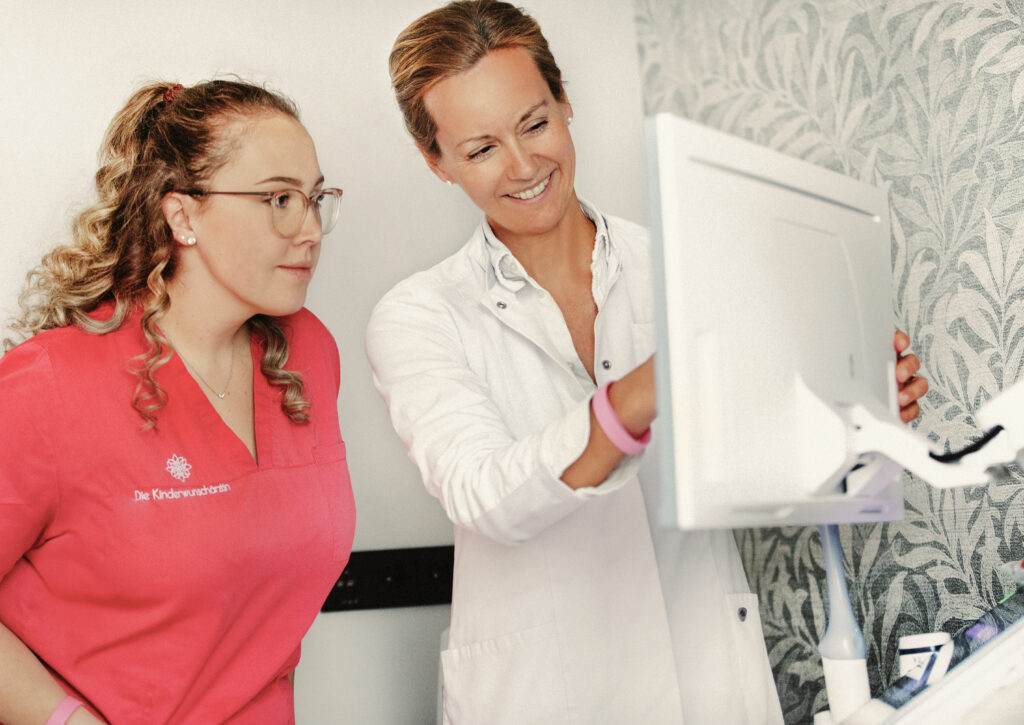
Our expert on VZO when trying to conceive
Cycle apps and calendar calculations can provide good initial guidance for regular cycles. However, they are usually based on past cycles and cannot reliably predict when ovulation will actually occur in the current cycle. Even small cycle fluctuations can shift the fertile days.
Ovulation can be narrowed down more precisely with ovulation tests or medical cycle monitoring. On ultrasound, we assess follicle growth and the build-up of the uterine lining. Additional hormone measurements help us determine the approaching ovulation as accurately as possible.
Timing is important: after ovulation, the egg can only be fertilized for about 12 to 24 hours, while sperm can survive for several days. This is why the days immediately before and around ovulation are particularly crucial.
Additional options when trying to conceive
In cases of cycle disorders or suboptimal egg maturation, the cycle can be supported with medication. Follicle maturation is monitored closely, and ovulation can be triggered in a targeted way if needed.
With insemination, prepared sperm are placed directly into the uterus at the optimal time. It can be a sensible next treatment option, for example, in cases of slightly reduced sperm quality.
If pregnancy does not occur despite good timing, further diagnostics may be useful—for example, to assess the fallopian tubes or sperm quality. This allows us to decide together which next step makes sense for you individually.
Timed intercourse (VZO) when trying to conceive: treatment process
At the private center Die Kinderwunschärztin in Munich, we guide you step by step through your treatment—individually and tailored to your cycle.
-
Initial Consultation
Together, we clarify whether VZO makes sense for your individual situation and discuss the process of cycle monitoring.
Make an appointment -
Start of the cycle
The first day of your period is the first day of your cycle. Based on your usual cycle length, we plan when the first check-up is appropriate.
-
Ultrasound
The ultrasound is usually performed between cycle days 8 and 12.
We assess the maturing follicle and the build-up of the uterine lining. Depending on how things develop, further follow-up checks may be useful to track egg maturation up to ovulation.
-
Hormone testing
In addition, we measure hormones such as estrogen, LH and progesterone. Together with the ultrasound, this allows us to assess how far egg maturation has progressed and when ovulation is approaching.
-
Optimal timing
Based on the ultrasound and hormone findings, we can determine the fertile window as precisely as possible and advise you on when intercourse is recommended.
-
Check-up after ovulation
If needed, progesterone levels can be measured after ovulation to ensure that ovulation has taken place. In addition, the second half of the cycle is assessed.
-
Pregnancy Test
About two weeks after ovulation, a pregnancy test will show whether pregnancy has occurred.
In some situations, it may be useful to support egg maturation hormonally—for example, in cases of irregular or absent follicle maturation, PCOS, or depending on age, ovarian reserve, and how long you have been trying to conceive.
A mild stimulation with hormone tablets such as letrozole is often sufficient. Alternatively, low-dose FSH or HMG preparations can be used. Follicle maturation is monitored by ultrasound and hormone measurements.
As soon as a follicle is sufficiently mature, ovulation can be triggered in a targeted way. This makes it possible to plan the optimal time for intercourse as precisely as possible.
Make an appointment
-
Personalized Support
We take time to answer your questions and support you personally throughout your cycle—individually and tailored to your situation.
-
Precise cycle monitoring
By combining ultrasound and hormone measurements, we can track egg maturation accurately and determine the fertile window as precisely as possible.
-
Many Years of Experience
Our many years of experience in reproductive medicine enable an individual assessment of your cycle and treatment that is precisely tailored to your prerequisites.
-
Flexible & uncomplicated
Short distances, digital communication, long opening hours, video consultations and online prescriptions make it easier to organize your treatment in everyday life.

What Our Patients Say

How much does “Verkehr zum Optimum” cost?
The costs for VZO depend on the examinations required for individual cycle monitoring. These mainly include ultrasound checks and hormone measurements, which we use to track follicle maturation and determine the timing of ovulation as precisely as possible.
To the cost overviewHow many check-ups are useful within one cycle depends on your cycle length, follicle maturation, and whether the cycle is natural or hormonally supported.
Make an appointmentNo fixed or flat-rate prices: We bill on the basis of the official scale of fees for doctors (GOÄ). According to the GOÄ, we are not allowed to quote fixed or flat-rate prices for medical services. The prices mentioned are intended to provide orientation and are typical for the treatments mentioned.
Possible VAT liability: Medical services may be subject to VAT (currently 19%). This applies if, after diagnostics have been carried out, no medical indication or confirmed diagnosis is present and it is therefore not a medical treatment in the strict sense. This can be the case in particular with social freezing treatments, but also with the treatment of single moms and same-sex couples.
We would be happy to provide you with detailed cost information for the planned treatment in advance. This allows you to clarify cost coverage with your private health insurance (PKV) as best as possible beforehand. Statutory health insurance (GKV) does not cover costs at our center.

Frequently asked questions about experiences with VZO and trying to conceive
What is VZO when trying to conceive?
VZO stands for “Verkehr zum Optimum” or “intercourse at the optimal time.” Using ultrasound and hormone measurements, we determine the fertile days as precisely as possible. This allows you to time intercourse to your fertile window and make the best possible use of your chances of becoming pregnant.
How does cycle monitoring work?
With cycle monitoring, we observe egg maturation by ultrasound and additionally measure hormones such as estrogen, LH and progesterone. We also assess the build-up of the uterine lining. Depending on how the cycle progresses, further check-ups may be useful. This allows the approaching ovulation to be narrowed down as precisely as possible.
How can you tell whether ovulation has occurred?
Whether ovulation has occurred can be assessed using ultrasound and hormone levels. In particular, the rise in progesterone after ovulation provides information. In many cases, the course of the ultrasound and hormone findings already makes it clear when ovulation took place.
Which injection triggers ovulation?
An hCG injection is often used to trigger ovulation in a targeted way. hCG acts similarly to the body’s own LH and usually leads to ovulation about 36 hours later. This allows the optimal time for intercourse to be planned very precisely.
How quickly do you get pregnant with VZO?
This varies greatly from person to person. The likelihood of pregnancy depends primarily on age, ovarian reserve, sperm quality, tubal patency, and other fertility factors. VZO helps you use the fertile window as precisely as possible—however, a specific pregnancy rate cannot be derived from this for every couple.
Is VZO also useful with an irregular cycle?
Yes. Especially with irregular cycles, VZO can be helpful because ovulation is often difficult to predict based on cycle length. With ultrasound and hormone measurements, we track egg maturation in the current cycle and can narrow down the fertile window much more precisely. In cases of pronounced cycle disorders, additional hormonal support may also be useful.
Can ovulation be triggered hormonally?
Yes. As soon as a sufficiently mature follicle can be seen on ultrasound and the hormone levels match, ovulation can be triggered in a targeted way with a trigger injection. This allows the fertile window to be planned even more precisely. Whether this is advisable is decided individually based on your cycle and findings.
When is the best time for intercourse when trying to conceive?
The highest likelihood of fertilization is in the days immediately before and around ovulation. Sperm can survive for several days in the female body, while the egg can only be fertilized for about 12 to 24 hours after ovulation. With VZO, we can give you specific recommendations on when intercourse is advisable based on your ultrasound and hormone findings.
How many cycles should you try VZO?
How long VZO is advisable depends on your individual situation. If the prerequisites are good, several VZO cycles may be reasonable. If pregnancy does not occur, we will discuss together whether further examinations, hormonal support, or another fertility treatment is advisable.