What is hormonal stimulation?
Hormonal stimulation specifically supports the growth of one or more follicles in the ovary. The goal and intensity of the treatment depend on your individual situation and the planned therapy.
In women with rare or absent ovulation, the treatment can serve to develop a single mature follicle and trigger ovulation. Stimulation can also be used specifically as part of an insemination. In contrast, for IVF, the maturation of several eggs is usually desired so that multiple eggs can be obtained during egg retrieval.
-
Tablets: Letrozole or Clomiphene
Tablets are often used as the first treatment option. They support the maturation of the follicles. Letrozole is frequently preferred today, especially for women with PCOS and absent or rare ovulation, as studies have associated it with higher ovulation, pregnancy, and live birth rates.
-
Injections (FSH / LH hormones)
If the follicles do not respond to stimulation in tablet form, or if stronger or more targeted stimulation is necessary, FSH or combined FSH/LH preparations can be used. The dosage is determined individually and accompanied by ultrasound and, if necessary, hormone checks so that the reaction of the ovaries can be precisely assessed and the treatment adjusted.
When is hormonal stimulation useful?
Hormonal stimulation can be used in different situations – depending on whether we want to support missing ovulation, better control the timing of an insemination, or bring several eggs to maturity as part of IVF/ICSI. Which form of stimulation is useful depends on your cycle, your age, your ovarian reserve, and the planned treatment.
- for long-term desire for children and increasing age
- when follicle maturation is to be specifically supported and the timing of ovulation better controlled as part of an insemination
- as part of an IVF or ICSI treatment, in which several follicles are specifically brought to maturity
Who can hormonal stimulation be suitable for?
 For cycle disorders or absent ovulation
If follicles do not mature regularly or ovulation occurs rarely or not at all – for example with PCOS – low-dose hormonal stimulation can support egg maturation and enable targeted ovulation. The goal here is usually the maturation of a single follicle.
At an advanced reproductive age or with a long-term desire for children
With increasing age – especially from the mid-30s and even more clearly from around 38 years – the probability that a single egg will lead to a pregnancy decreases. Depending on the form of treatment, hormonal stimulation can therefore be useful to bring several follicles to maturity in one cycle and increase the chances per cycle. This approach can also improve the chances of pregnancy if the desire for children has existed for a longer period.
Before an insemination
Before an IUI, hormonal stimulation can support follicle maturation and optimally coordinate the timing of the insemination with ovulation. Depending on age and the initial situation, the maturation of several follicles may be useful to increase the chance of pregnancy per cycle. In doing so, we take care to keep the risk of multiple pregnancies low.
For IVF or ICSI
Hormonal stimulation is an important part of therapy in IVF or ICSI treatment. The goal is to bring several follicles to maturity at the same time so that as many eggs as possible can be obtained during egg retrieval. How strongly we stimulate and which protocol is suitable is individually tailored to ovarian reserve, age, and previous treatments.
Social Freezing treatment
Hormonal stimulation is also an important part of treatment in social freezing. The goal is to bring several follicles to maturity in one cycle and obtain as many eggs as possible, which can then be cryopreserved.
Expert Assessment
Gold standard
Hormonal stimulation is a proven and well-controllable treatment option in fertility medicine. Depending on the initial situation, it can be used in very different ways – for example, to support an irregular cycle, as part of natural cycle optimization, before an insemination, or as part of an IVF or ICSI treatment.
It is crucial for us to dose the treatment individually and to provide close monitoring. This allows us to precisely assess the reaction of the ovaries, adjust the medication if necessary, and specifically control the number of maturing follicles.
Process of Hormone Treatment for Fertility
Hormonal stimulation is individually tailored to your cycle, your ovarian reserve, and the planned treatment. During the treatment, we regularly monitor follicle maturation and adjust the medication if necessary.
-
Initial Consultation and Basic Examinations
At the beginning, we discuss your medical history, existing findings, and your cycle. Through ultrasound and hormone diagnostics, we assess your ovarian reserve, among other things, and determine the type of stimulation and dosage on this basis.
Make an appointment -
Start of Stimulation
Depending on the treatment goal, you start with tablets or hormone injections. We determine the dosage and duration of treatment individually and adjust them to the reaction of your ovaries.
-
Ultrasound and Hormone Monitoring
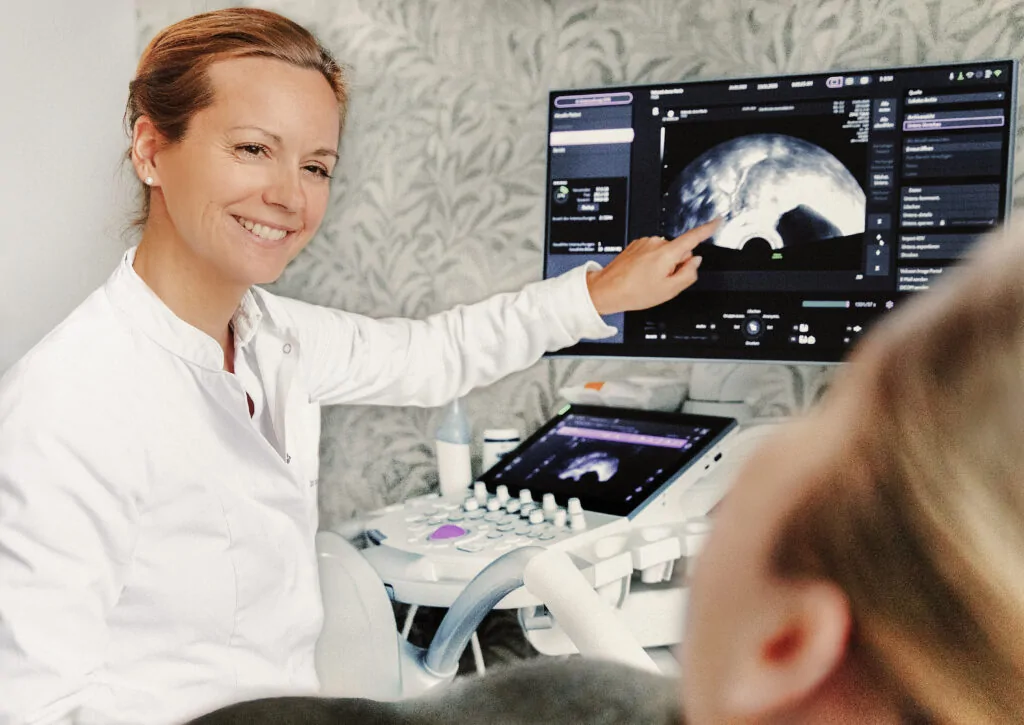
During the process, we monitor the growth of the follicles and the uterine lining using ultrasound and hormone determination. This allows us to assess how your ovaries are reacting and when the next treatment step is appropriate.
-
Triggering Egg Maturation
When the follicles are sufficiently developed, final egg maturation is initiated with a so-called trigger shot. For sexual intercourse or insemination, this allows the timing of ovulation to be specifically planned. For IVF, ICSI, or social freezing, we coordinate the timing of the egg retrieval accordingly.
-
Next Treatment Step
Depending on the treatment, sexual intercourse, insemination, or – in the case of IVF, ICSI, and social freezing – egg retrieval follows at the appropriate time.
-
Pregnancy Test
After sexual intercourse or insemination, a pregnancy test can be taken about two weeks after ovulation. For IVF or ICSI, a pregnancy test is performed two weeks after the retrieval.

Hormonal Stimulation for Fertility – Your Advantages with Us
Schedule a consultation-
Personalized Support
Your dedicated fertility doctor accompanies you throughout the entire stimulation, knows your history, and can adjust the treatment individually as it progresses.
-
Individually Tailored Therapy
We dose the stimulation individually to enable a well-tolerated and safe treatment.
-
In-house hormone laboratory
Hormone levels are determined directly at our clinic and are available to us within a few hours, so that the next treatment steps can be planned promptly.
-
Good Accessibility & Flexible Appointments
Early monitoring appointments, short communication channels, and good accessibility make treatment easier in everyday life. If you have questions about medication, dosage, or the further process, you will receive feedback quickly.

What Our Patients Say

Risks of Hormonal Stimulation
Side Effects of Medication
Different side effects can occur depending on the medication. Most medications are well tolerated. Temporary mild symptoms such as mood swings, headaches, dizziness, and hot flashes may occur. With higher stimulation, a feeling of pressure in the lower abdomen can also arise due to the growing follicles.
Risk of Multiple Pregnancies
If several follicles mature at the same time, the risk of a multiple pregnancy increases. How high this risk is depends, among other things, on the medication used, the number and size of the follicles, and age. Therefore, we monitor follicle development closely and adjust the treatment if necessary. In pure ovulation induction, the goal is usually the maturation of a single follicle.
Ovarian Hyperstimulation Syndrome
Especially with stimulation using gonadotropins as part of IVF, ICSI, or social freezing, ovarian hyperstimulation syndrome (OHSS) can occur in rare cases. Through individually adjusted dosages, regular ultrasound and hormone monitoring, and modern stimulation protocols, the risk is significantly reduced today.
Absent or Insufficient Reaction
Sometimes the ovaries respond very little to the stimulation or a cycle does not develop as expected. In such cases, we adjust the dosage or review together which further course of action is appropriate.
Costs of Hormonal Stimulation
The costs of hormonal stimulation depend on the individual treatment plan, the duration of the therapy, and the required scope of medication. Generally, the total costs consist of medical services such as consultation, ultrasound monitoring, and hormone analyses, as well as the prescribed stimulation medications.
To the cost overviewalso includes reproductive medicine ultrasound and a basic examination of hormones in our laboratory
(up to 1 hour)
Cycle monitoring serves the close monitoring of stimulation by means of ultrasound examinations and blood samples in order to safely control follicle growth and plan the timing for ovulation.
Make an appointmentIn addition to the treatment costs mentioned, the following costs are usually added. The amount depends, among other things, on the chosen treatment protocol and the individual situation.
- Medications for hormonal stimulation (approx. €400–1,500 depending on stimulation and ovarian reserve)
No fixed or flat-rate prices: We bill on the basis of the official scale of fees for doctors (GOÄ). According to the GOÄ, we are not allowed to quote fixed or flat-rate prices for medical services. The prices mentioned are intended to provide orientation and are typical for the treatments mentioned.
Possible VAT liability: Medical services may be subject to VAT (currently 19%). This applies if, after diagnostics have been carried out, no medical indication or confirmed diagnosis is present and it is therefore not a medical treatment in the strict sense. This can be the case in particular with social freezing treatments, but also with the treatment of single moms and same-sex couples.
We would be happy to provide you with detailed cost information for the planned treatment in advance. This allows you to clarify cost coverage with your private health insurance (PKV) as best as possible beforehand. Statutory health insurance (GKV) does not cover costs at our center.

Frequently Asked Questions about Hormonal Stimulation in Munich
How long does hormonal stimulation for fertility take?
Hormonal stimulation is performed in the follicular phase of a cycle (1st half of the cycle) and usually lasts about 8 to 14 days. The duration depends on the reaction of the follicles.
In the case of cycle disorders, such as PCOS, it can sometimes take longer for a follicle to mature sufficiently. If pregnancy does not occur in the first cycle, several treatment cycles in succession may be useful.
Do I have to come in for monitoring frequently during stimulation?
Regular ultrasound checks are important to assess follicle maturation and number and to adjust medication. Depending on the progress, hormone levels are also determined. The intervals depend on how your ovaries react.
Can I work and do sports during hormonal stimulation?
As a rule, the treatment can be very well integrated into everyday life. In the case of significantly enlarged ovaries or increasing symptoms, we recommend reducing intensive sporting activities. We will discuss what is appropriate in your situation individually.
How high is the success rate for hormonal stimulation?
The success rate depends primarily on age and the cause of the unfulfilled desire for children. If, for example, follicle maturation is disturbed and all other requirements are favorable, the chances per cycle can be good. With increasing age, the probability of pregnancy per egg decreases, so that other or additional treatment steps often become useful.
How high your personal chances are can therefore best be estimated based on your individual initial situation.
What happens if the body does not react to the treatment?
It can happen that no follicle matures. In that case, depending on the situation, we adjust the dosage or the medication and review the further course of action. In doing so, we particularly take into account age, ovarian reserve, and the previous reaction to the treatment.
Can hormonal stimulation increase the risk of multiples?
Yes, hormonal stimulation can increase the risk of multiple pregnancies if several follicles mature at the same time. How high the risk is depends in particular on the number of matured follicles, age, and the type of treatment. Through close ultrasound and hormone monitoring, the treatment can be individually adjusted and safely accompanied.
Is alcohol allowed during hormonal stimulation?
During hormonal stimulation, we recommend avoiding alcohol as much as possible or consuming only very little. Nicotine should also be avoided, and folic acid should already be taken when trying to conceive.