What is Insemination (IUI)?
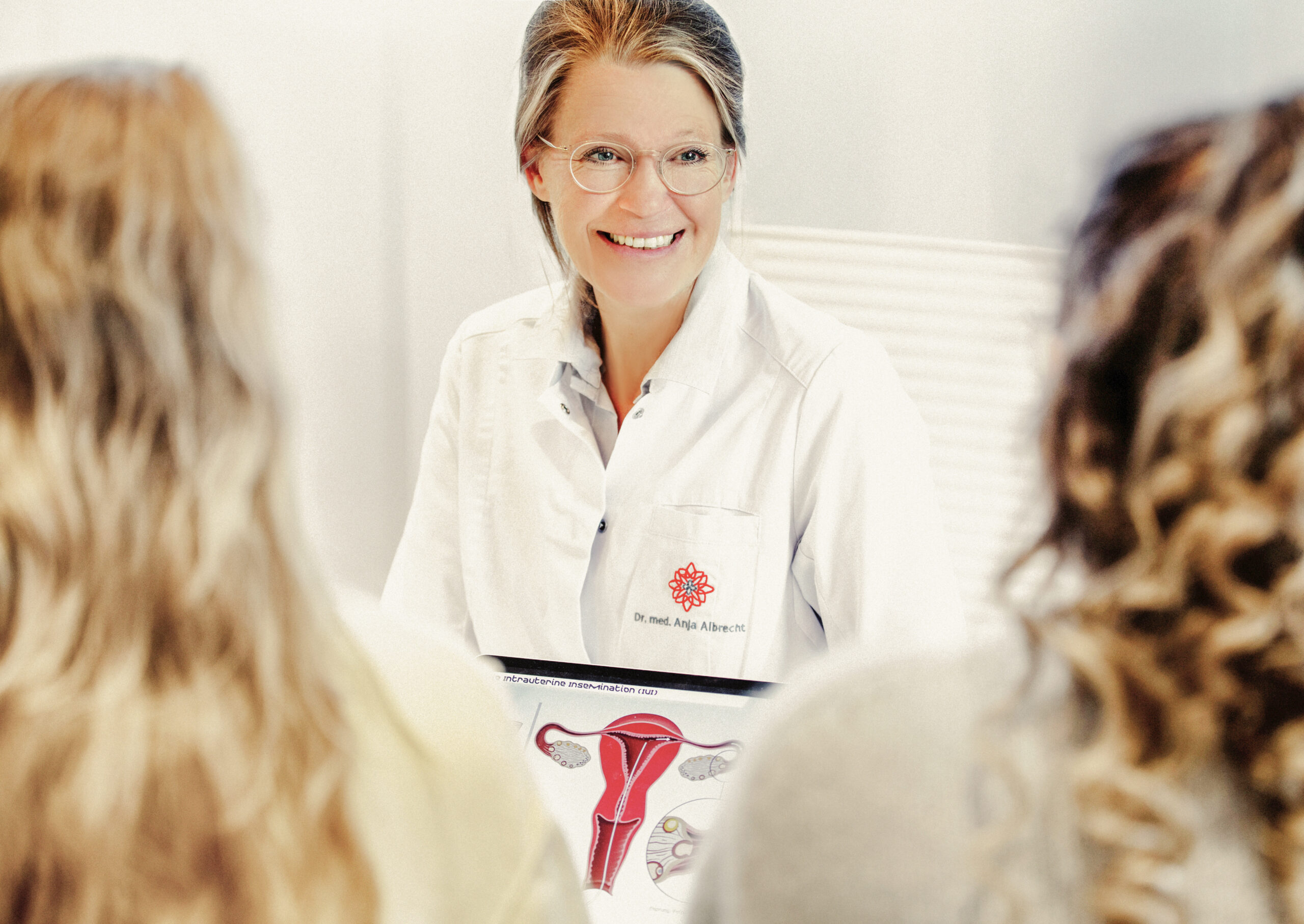
Intrauterine insemination (IUI) is an established and relatively simple method of fertility treatment. Prepared sperm cells are introduced directly into the uterus at the optimal time. This shortens the path of the sperm to the egg and supports the chance of fertilization. The treatment only takes a few minutes and is usually pain-free.
The treatment can be performed in a natural cycle or with mild hormonal support. The appropriate approach depends on the individual situation and will be determined together with you.
-
Homologous Insemination
In homologous insemination, the partner’s sperm are used. It is the most frequently performed form of insemination for couples with unfulfilled desire to have children.
-
Donor / Heterologous Insemination
In donor insemination, donor sperm are used. This is an option for women without a partner, lesbian couples, or couples with severe male infertility, among others.
When is Insemination Recommended?
Insemination can be particularly useful in the following situations:
- Unexplained infertility despite unremarkable basic diagnostics
- Slightly reduced sperm quality with sufficient motile sperm
- When the chances of natural fertilization are to be specifically supported
- Mild endometriosis
- Erectile or ejaculation disorders, as well as vaginismus, if these make sexual intercourse or natural fertilization difficult
Who is Insemination Suitable For?
 Couples
For heterosexual couples, insemination can be a gentle first treatment option. For example, in cases of slightly reduced sperm quality, unexplained infertility, or when sexual intercourse is difficult.
Lesbian couples
As part of fertility treatment with donor sperm, insemination offers lesbian couples a medically supervised way to fulfill their desire to have children.
Single women
Women without a partner can be treated with donor sperm through insemination.
Women over 40
With increasing age, the chance of pregnancy per insemination cycle decreases. Therefore, especially from around 40 years of age, we carefully examine whether insemination is still advisable or if IVF/ICSI offers better chances of success for you.
What Do the Success Rates of Insemination Depend On?
Whether insemination is advisable and promising depends on several factors:
- Age and ovarian reserve
- Patency of the fallopian tubes
- Cycle and ovulation
- Quality and number of motile sperm
- Underlying cause of infertility
- Number and course of previous treatments
If the conditions for insemination are unfavorable or several attempts have been unsuccessful, we will discuss with you whether IVF or ICSI might be a better next treatment option.


Our Assessment of Insemination as a Treatment Method
Gold standard
Insemination is one of the established and gentle methods of fertility treatment. It is particularly suitable for mild fertility impairment – for example, reduced sperm quality with sufficient motile sperm, a cervical factor where cervical mucus hinders the sperm’s path, or irregular cycles with unpredictable ovulation. In these situations, IUI can specifically support the natural fertilization process and increase the chances of pregnancy.
Our experience shows that insemination is most promising when the basic conditions are met: patent fallopian tubes and sufficient motile sperm. Through cycle monitoring and, if necessary, mild hormonal support, ovulation can be reliably monitored or specifically triggered, allowing the treatment to take place at the optimal time.
Supplementary Options for Insemination
With regular ultrasound and hormone checks, ovulation is precisely monitored. This allows insemination to be performed at the optimal time – an important factor for treatment success.
Mild hormonal stimulation may be advisable if follicle maturation does not occur naturally or if one to two follicles are to be specifically matured to increase the chance of pregnancy. Additionally, ovulation can be triggered precisely so that insemination occurs at the optimal time.
For insemination with donor sperm, we personally accompany you through the entire process – from medical preparation to selection and organization with the sperm bank, and treatment planning. We tailor the insemination individually to your cycle and personal situation.
If you desire additional support, we are happy to connect you with experienced contacts from our network – for example, for nutritional counseling, Traditional Chinese Medicine (TCM), or psychological support. This way, you can individually supplement your fertility treatment if needed.
Insemination Process for Fertility Treatment
In our fertility center, we accompany you step by step through the treatment and plan the process so that it can be easily integrated into your daily life.
-
Treatment Planning
In the initial consultation, we discuss your personal situation and jointly decide whether insemination will be performed in a natural cycle or with mild hormonal support.
Make an appointment -
Cycle Monitoring and Appointment Scheduling
With ultrasound and hormone checks, we observe follicle maturation and determine the optimal time for insemination. If advisable, ovulation can be specifically triggered.
-
Semen Sample Collection
On the day of insemination, you can either provide the semen sample at our center or bring it from home. We will provide you with a suitable sterile container for collection. If you bring the sample from home, it should reach us within approximately 30 to 40 minutes and be transported warmly, close to the body.
Before collection, we generally recommend sexual abstinence of about two to five days. Depending on sperm quality, the optimal abstinence period can be adjusted individually.
It is important to us that this step is as uncomplicated and comfortable for you as possible – many men initially find semen collection unfamiliar, which is why we calmly explain the process beforehand and answer all questions. -
Sperm Preparation
The semen sample is prepared in our laboratory so that a concentrated sample with highly motile sperm is available for insemination. Preparation usually takes about 1.5 hours.
-
The Insemination
With a thin, soft catheter, the prepared sperm are carefully introduced into the uterus. The treatment only takes a few minutes and is usually pain-free. Afterwards, you can go home directly and resume your normal daily routine.
-
Pregnancy Test
Approximately 14 days after insemination, a pregnancy test can be performed – either a urine test at home or a blood test at our fertility center. Afterwards, we will discuss the result and the further course of action together.

-
Personalized Support
Throughout the entire fertility treatment, you will be accompanied by a dedicated doctor who knows your situation and responds to your individual needs.
-
Individual Treatment Planning
Whether natural cycle, mild hormonal support, or insemination with donor sperm – we choose the approach that suits your medical situation and personal wishes.
-
Precise and Flexible Cycle Monitoring
With ultrasound and hormone checks, we determine the optimal time for insemination and flexibly adapt the treatment to your cycle. Early control appointments and short communication channels facilitate treatment in everyday life.
-
A realistic assessment of your chances
We carefully check whether insemination is advisable in your situation. If IVF or ICSI offers significantly better chances of success, we will discuss this openly with you at an early stage.
Overview of Pregnancy Chances with Insemination
The chances of success of an insemination depend primarily on the woman’s age, the cause of infertility, sperm quality, and whether partner or donor sperm is used. A natural or stimulated cycle can also make a difference.
Generally, the chance of pregnancy per insemination cycle decreases with increasing age. In treatment with donor sperm, the chances, especially for younger women, are often significantly higher than with insemination due to reduced sperm quality.
We will discuss your individual chances of success in detail during a personal consultation.

What Our Patients Say

Possible Risks and Limitations of Insemination
Low risk of pain or discomfort
Insemination is usually pain-free. Occasionally, a slight pulling sensation may occur, similar to a gynecological examination. There are no surgical risks.
Short-term reactions after sperm insertion
Some patients report a slight pressure sensation in the lower abdomen after the treatment. These sensations usually subside quickly and do not affect daily life.
Medical prerequisites
For insemination, at least one fallopian tube should be patent. For treatment with partner sperm, sufficient motile sperm must also be present. If these conditions are not met, IVF or ICSI may be more appropriate.
Risks with hormonal stimulation
If insemination is combined with hormonal stimulation, multiple follicles may mature. This increases the risk of a multiple pregnancy. Therefore, we carefully monitor follicle development and adjust treatment if necessary.
Limited chance of success per cycle
Even with good conditions, not every insemination leads to pregnancy. Therefore, before starting, we realistically discuss your individual chances and how many attempts seem appropriate in your situation.

Costs of Insemination (IUI)
The costs of insemination depend on the type of treatment (with partner or donor sperm) and the individual scope of treatment. This includes, in particular, the necessary cycle monitoring and possible hormonal support. Since each treatment is planned individually, the total costs can vary.
To the cost overviewInsemination with partner sperm including semen sample preparation and treatment performance.
The required appointments for cycle monitoring and hormone checks are not included.
Insemination with donor sperm including medical and organizational preparation as well as treatment performance.
The required appointments for cycle monitoring and hormone checks are not included.
Ultrasound and hormone checks to determine the optimal time for insemination. Usually 1–3 appointments are needed.
approx. €150–170 (homologous IUI) or approx. €180–200 (heterologous IUI) per appointment
No fixed or flat-rate prices: We bill on the basis of the official scale of fees for doctors (GOÄ). According to the GOÄ, we are not allowed to quote fixed or flat-rate prices for medical services. The prices mentioned are intended to provide orientation and are typical for the treatments mentioned.
Possible VAT liability: Medical services may be subject to VAT (currently 19%). This applies if, after diagnostics have been carried out, no medical indication or confirmed diagnosis is present and it is therefore not a medical treatment in the strict sense. This can be the case in particular with social freezing treatments, but also with the treatment of single moms and same-sex couples.
We would be happy to provide you with detailed cost information for the planned treatment in advance. This allows you to clarify cost coverage with your private health insurance (PKV) as best as possible beforehand. Statutory health insurance (GKV) does not cover costs at our center.

Frequently Asked Questions about Insemination in Munich
When is insemination recommended?
Insemination is recommended when the basic conditions for natural fertilization are met, but specific support is desired. For example, in cases of unexplained infertility, slightly reduced sperm quality, mild endometriosis, certain erectile or ejaculation disorders, and in treatment with donor sperm. We will discuss whether IUI is appropriate for your individual situation in a personal consultation.
What are the prerequisites for insemination?
For insemination, at least one fallopian tube should be patent and sufficient motile sperm must be present. We clarify whether these conditions are met during diagnostics and advise you individually on the suitable treatment.
What is insemination?
Insemination is a fertility treatment in which prepared sperm are introduced directly into the uterus. The procedure is short, pain-free, and supports natural fertilization.
How does insemination work?
First, we determine the appropriate time through cycle monitoring. The semen sample is prepared in the laboratory, and then the concentrated motile sperm are flushed into the uterus with a thin catheter. The actual insemination only takes a few minutes.
When is IVF or ICSI more appropriate than insemination?
IVF or ICSI may be appropriate if the chances of success with insemination are low due to the individual initial situation. This can be the case, for example, with blocked fallopian tubes, significantly reduced sperm quality, higher maternal age, or after several unsuccessful inseminations. We will discuss which treatment offers the best chances of success based on your personal situation.
Is insemination painful?
Generally not. The treatment is similar to a gynecological examination and only takes a few minutes.
How long does insemination take?
The actual procedure only takes a few minutes. The preparation of the semen sample takes about 1.5 to 2 hours.
Can one continue to work and exercise normally after insemination?
Yes. After a short rest, you can resume your daily routine as usual. A longer rest period or bed rest is not necessary.
When does insemination take place in relation to ovulation?
Insemination is performed as close to ovulation as possible. We determine the optimal time based on ultrasound, hormones, and, if necessary, a targeted ovulation trigger.
When is it tested whether insemination was successful?
Approximately 14 days after insemination, a pregnancy test can be performed using urine or blood.
What is the success rate of insemination?
The chance of pregnancy depends heavily on age, ovarian reserve, sperm quality, the cause of infertility, and the type of treatment. The use of partner or donor sperm and possible stimulation also play a role. Therefore, we discuss your personal chances of success individually.
Can insemination also be useful for endometriosis?
Yes, especially with mild endometriosis, insemination – often in conjunction with mild stimulation – can be a treatment option. Whether this is advisable depends, among other things, on age, ovarian reserve, duration of infertility, and other fertility factors.
How many inseminations are advisable?
This depends on age, initial situation, and previous treatments. For unexplained infertility, several IUI cycles may be advisable. Depending on age, three to six cycles are performed. With less favorable conditions or increasing age, it may be advisable to consider IVF or ICSI earlier.
How many days before ovulation does insemination take place?
IUI is performed at the optimal time, which is determined by ultrasound or ovulation trigger.
What could be the reason if an insemination is not successful?
The chances of success depend significantly on age, cycle quality, and sperm parameters. Often, several cycles are necessary before success occurs.
Is insemination better in a natural or stimulated cycle?
Both are possible. In a natural cycle, we utilize the body’s own follicle maturation. Mild stimulation may be advisable if follicle maturation needs support or if several follicles are to be specifically developed. We decide individually which option is better for you.
Is there a risk of multiple pregnancies with insemination?
Insemination itself does not increase the risk of multiple pregnancies. However, if multiple follicles develop as part of hormonal stimulation, the risk of a multiple pregnancy can increase. Therefore, we carefully monitor follicle development.
Can insemination be performed with donor sperm?
Yes. IUI with donor sperm is possible for women without a partner, lesbian couples, and couples with severe male infertility, among others. We accompany you from medical planning to treatment.
Can I do anything myself for the treatment?
A healthy lifestyle, abstinence from nicotine, and the recommended intake of folic acid are generally advisable in preparation for pregnancy. However, the medical prerequisites and the correct timing of treatment are crucial for the success of insemination.
What are the costs for insemination?
The costs depend on whether insemination is performed in a natural or stimulated cycle and which examinations and laboratory services are necessary. Before starting treatment, you will receive a transparent overview of the estimated costs from us.
Whether and to what extent private health insurance covers the costs depends on the individual tariff and the medical indication.