What is Cycle Monitoring?
Cycle monitoring enables a targeted assessment of your cycle and fertility. We use ultrasound to check the growth of the follicle (egg sac) as well as relevant hormone levels such as estradiol, LH, and progesterone. Additionally, we assess whether the hormonal environment and the buildup of the uterine lining provide optimal conditions for fertilization and implantation.
Cycle monitoring provides far more information than just determining fertile days. It shows whether a follicle is maturing correctly, whether ovulation actually takes place, how the uterine lining develops, and whether there are hormonal abnormalities that could make pregnancy more difficult.
In this way, it can be determined whether the egg is maturing normally, whether ovulation is taking place, and when the most favorable time is for sexual intercourse or further fertility treatment.
When is Cycle Monitoring Useful?
Cycle monitoring can be helpful in various situations:
- For irregular menstrual cycles
- When pregnancy does not occur despite regular sexual intercourse
- For the precise determination of fertile days
- For targeted support of natural conception
- If absent or irregular ovulation is suspected
- For PCOS/PCO or other hormonal cycle disorders
- In preparation for fertility treatment (IUI, IVF, or ICSI)
Who is Cycle Monitoring Suitable For?
 Couples
Cycle monitoring helps to accompany the cycle in a targeted manner and improve the chances of pregnancy – especially in the case of an irregular cycle, a long-standing desire for a child, or in preparation for fertility treatment.
Lesbian couples
For lesbian couples, cycle monitoring can help to assess the individual requirements for insemination and determine the optimal time for treatment.
Single women
Cycle monitoring supports single women in better understanding their own cycle processes and specifically assessing the requirements for fertility treatment.
Women over 40
Even with a regular cycle, the probability of pregnancy decreases with age. Ovulation can fail to occur from time to time. For women over 40 who wish to have a child, cycle monitoring helps to determine the fertile phase as accurately as possible and to recognize possible abnormalities early on.

The Process of Cycle Monitoring
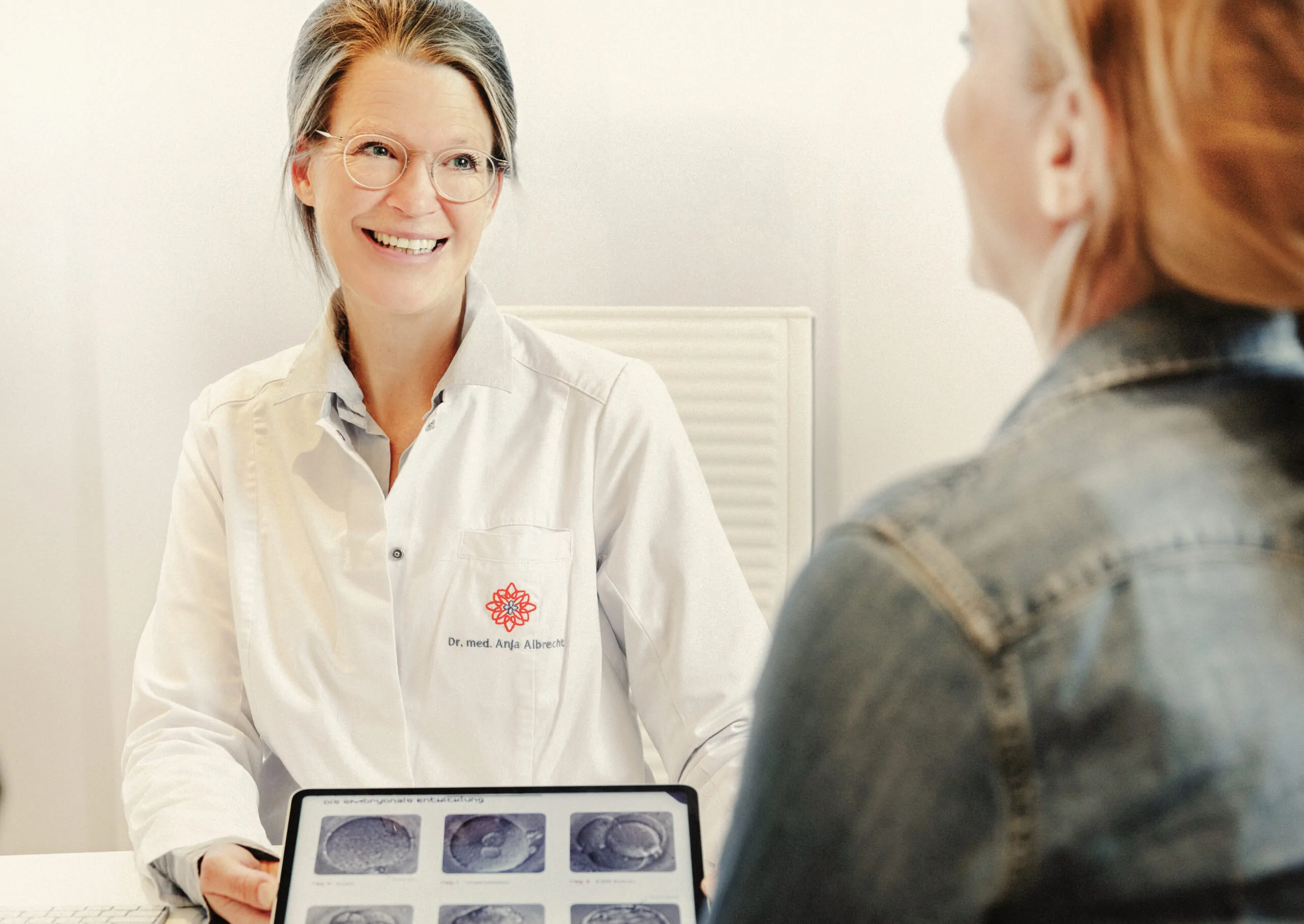
Cycle monitoring takes place at our fertility center in Munich in several clearly coordinated steps. We accompany you closely and adapt the timing and scope of the examinations individually to your cycle and your personal situation. Depending on the question, one or more ultrasound and blood tests may be necessary.
-
Initial Consultation
It begins with a detailed consultation in which we discuss your cycle, possible irregularities, and your previous fertility history. Together, we plan the optimal time for the first ultrasound appointment and explain the entire process of cycle monitoring to you.
Make an appointment -
First Ultrasound (usually between cycle days 8–12, we adjust the appointment individually depending on cycle length)
During the first ultrasound examination, we assess the growing egg sac (follicle) and can estimate when ovulation is to be expected. At the same time, we assess the uterine lining, as its thickness and structure are important prerequisites for successful implantation.
-
Second Ultrasound (2–3 days later)
About two to three days later, we check the follicle growth and hormone levels again. Based on the development, the time of ovulation can be further narrowed down. In addition, we recognize whether the follicle is developing normally or whether there are abnormalities that could influence the further treatment plan.
-
Hormone testing
Parallel to the ultrasound checks, we determine – depending on the question – estradiol, LH, FSH, and progesterone, among others. These values help to more accurately categorize the development of the egg sac and the time of ovulation. The combination of ultrasound and hormone analysis allows for a significantly more precise assessment than individual hormone or urine tests alone.
-
Optimal Time for Fertilization
If ovulation is imminent, we give you clear guidance on when the best time for sexual intercourse or – depending on the situation – a planned treatment is. This allows the probability of fertilization to be improved in a targeted manner.
-
Confirmation of Ovulation
About seven days after the LH surge, we examine the so-called luteal phase (corpus luteum phase). Based on the progesterone value, we can determine whether ovulation has actually taken place and whether the corpus luteum is producing sufficient progesterone. Additionally, we check the estradiol level and assess whether the hormonal
conditions for implantation are favorable. The length of the luteal phase also provides important clues about cycle quality and possible causes of unfulfilled desire for children. Around 14 days after ovulation, a pregnancy test can be performed – either at home or at our fertility center by means of a blood test (hCG test).
Cycle Monitoring from a Medical Perspective
Gold standard
In modern reproductive medicine, cycle monitoring is one of the most reliable methods for assessing the cycle and the fertile phase. In contrast to cycle apps, temperature curves, or urine tests, it provides direct information on follicle growth and relevant hormone levels.
A positive LH test or a cycle app can only estimate the upcoming ovulation. However, whether the egg has actually been released and the uterine lining has developed optimally can only be reliably assessed through the combination of ultrasound and hormone examinations.
This not only allows ovulation to be determined more accurately, but also makes it possible to assess whether the conditions for fertilization are met. This enables targeted planning – both for the desire for a child naturally and within the framework of insemination or IVF treatment.
Supplementary Examinations & Treatments
In certain situations, checking the fallopian tubes can be useful to assess their patency. This clarifies whether the path for the egg is clear and whether this represents a possible cause for an unfulfilled desire for children. The results help to plan further treatment in a targeted manner.
In certain cases, mild hormonal stimulation can be useful to specifically support the maturation of one or more follicles. The stimulation is individually tailored and closely monitored to optimally accompany the cycle and improve the chances of pregnancy – whether in a natural cycle, as part of insemination, or to prepare for further fertility treatment.

-
Personalized Support
The same doctor accompanies you throughout, from the initial consultation to the evaluation.
-
Precise diagnostics
Modern ultrasound technology and targeted hormone analyses enable an accurate assessment of the cycle and the determination of ovulation.
-
Holistic Approach
Upon request, we include supplementary measures such as nutritional counseling, TCM, or psychological support in the treatment.
-
In-house hormone laboratory
Fast results and clear communication – usually on the same day.
-
Easily Accessible and Flexible
Central location in Munich and appointments in the early morning or evening for good compatibility with everyday life.

What Our Patients Say


Your Chances of Pregnancy During the Cycle
The probability of becoming pregnant is not the same on all days of the cycle. The decisive factor is the so-called fertile window, which begins five to seven days before ovulation. The reason for this is that sperm can survive for several days in the female genital tract under favorable conditions and “wait” for ovulation.
The highest chances of pregnancy exist one to two days before ovulation and on the day of ovulation. After ovulation, the probability of pregnancy then decreases, as the egg is only capable of being fertilized for about 12 to 24 hours. Once this 24-hour window has passed, natural pregnancy is no longer possible in this cycle.
Cycle monitoring helps to determine the time of ovulation as accurately as possible and to make optimal use of the fertile window – whether for natural conception or as part of fertility treatment.
Probability of Pregnancy Depending on the Cycle Phase
We will discuss your individual chances in detail during a personal consultation.
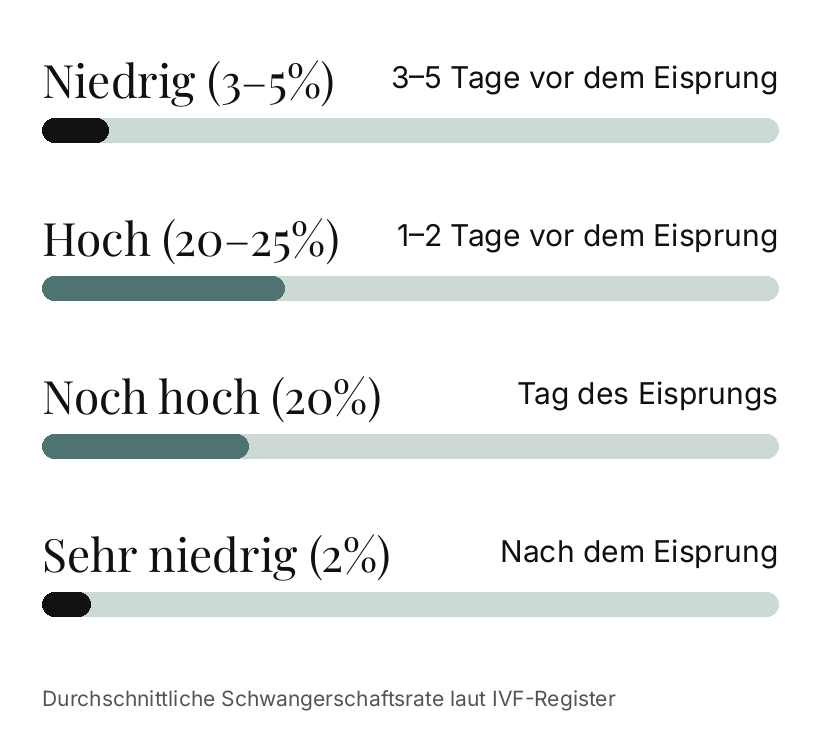
The probabilities given are guide values for healthy couples with regular sexual intercourse without known fertility disorders. Individual pregnancy probability depends, among other things, on the woman’s age, egg and sperm quality, and other medical factors, and may deviate from these values. The information is based on data from the classic study by Wilcox et al. (New England Journal of Medicine) on natural conception and the current recommendations of the American Society for Reproductive Medicine (ASRM).
We will discuss your individual chances in detail during a personal consultation.
Calculate your due date
Enter your conception details to estimate your due date and track your pregnancy progress.
How did you conceive?

Watch Sophie & Robert’s Story Together
What it meant to feel truly seen, supported, and accompanied every step of the way.
Costs for Cycle Monitoring
Cycle monitoring usually consists of several ultrasound examinations and is generally expanded by supplementary blood tests.
To the cost overviewCycle monitoring with ultrasound is one of the most important examinations for an unfulfilled desire for children. We assess follicle growth and track the course of the cycle in a targeted manner.
Supplementary blood tests may be useful depending on the question and are billed separately.
Make an appointmentNo fixed or flat-rate prices: We bill on the basis of the official scale of fees for doctors (GOÄ). According to the GOÄ, we are not allowed to quote fixed or flat-rate prices for medical services. The prices mentioned are intended to provide orientation and are typical for the treatments mentioned.
Possible VAT liability: Medical services may be subject to VAT (currently 19%). This applies if, after diagnostics have been carried out, no medical indication or confirmed diagnosis is present and it is therefore not a medical treatment in the strict sense. This can be the case in particular with social freezing treatments, but also with the treatment of single moms and same-sex couples.
We would be happy to provide you with detailed cost information for the planned treatment in advance. This allows you to clarify cost coverage with your private health insurance (PKV) as best as possible beforehand. Statutory health insurance (GKV) does not cover costs at our center.

Frequently Asked Questions about Cycle Monitoring
What happens during cycle monitoring?
We observe the cycle using ultrasound examinations and – if necessary – supplementary blood tests. This allows us to see how the egg sac develops, whether ovulation takes place, how the uterine lining builds up, and when the fertile phase begins.
When is cycle monitoring useful?
Cycle monitoring can be useful if your cycle is irregular or if pregnancy has not yet occurred. It can also be helpful if it is unclear whether ovulation is taking place, or for the targeted planning of insemination or IVF treatment.
On which days of the cycle is monitoring performed?
The first ultrasound appointment usually takes place between the 8th and 12th day of the cycle. The appointment is adjusted individually depending on the length of the cycle. Further checks take place at intervals of two to three days – depending on the development of the follicle and individually coordinated.
How often does cycle monitoring take place per cycle?
Two to three appointments are usually required in one cycle. The exact number depends on the individual course of the cycle and the development of the follicle.
Can cycle monitoring increase the chances of pregnancy?
Cycle monitoring itself is not a treatment, but a diagnostic examination. However, it helps to reliably determine ovulation, recognize hormonal abnormalities early on, and establish the optimal time for sexual intercourse or fertility treatment. This can improve the chances of pregnancy and allow further treatment steps to be planned in a targeted manner.
Is an ovulation test not sufficient?
Ovulation tests measure the surge in the LH hormone and can indicate upcoming ovulation. However, they do not show for certain whether ovulation has actually taken place. Cycle monitoring combines ultrasound and hormone examinations, thereby enabling a significantly more accurate assessment of egg maturation, ovulation, and the uterine lining.
Is cycle monitoring painful?
The vaginal ultrasound examination is usually painless and only takes a few minutes.
Can cycle monitoring determine if I am ovulating?
Yes. Through the combination of ultrasound and hormone analysis, it can be reliably assessed whether ovulation has taken place. At the same time, possible causes for absent or irregular ovulation can be identified.
How much does cycle monitoring cost?
The costs for cycle monitoring with ultrasound and blood tests are usually between 150 and 170 euros per appointment (according to the GOÄ fee schedule).
Does health insurance cover the costs of cycle monitoring?
As a private fertility center, we bill all services according to the Fee Schedule for Doctors (GOÄ). Direct billing with statutory health insurance companies is therefore not possible. Private health insurance companies or aid agencies usually cover the costs in full or in part, depending on the individual tariff. We will be happy to inform you transparently about the expected costs before treatment begins.
Patients with statutory insurance are, of course, also welcome and can take advantage of the treatment as self-payers.