What is DNA fragmentation?
Sperm transport paternal genetic information to the egg cell. If there are breaks or damage in the DNA of the sperm cells, this is referred to as increased DNA fragmentation.
An increased proportion of fragmented sperm can influence fertilization and early embryonic development and may be associated with a lower probability of pregnancy or an increased risk of miscarriage.
When is a DNA fragmentation test useful?
An examination of sperm DNA can meaningfully supplement fertility diagnostics in various situations:
 In cases of unfulfilled desire to have children despite an inconspicuous spermiogram
Increased DNA fragmentation can be present in both an abnormal and an inconspicuous spermiogram. Especially when no pregnancy occurs despite largely inconspicuous standard diagnostics, the examination can provide additional information, as DNA damage is not visible in a classic spermiogram.
In cases of unsuccessful IVF/ICSI treatments
If several fertility treatments have remained unsuccessful, increased DNA fragmentation of the sperm may be a possible contributing cause. The examination can help to further assess sperm quality.
In cases of repeated miscarriages
The examination of sperm DNA can also be useful in cases of repeated miscarriages. Increased DNA fragmentation is associated with impaired early embryonic development and an increased risk of miscarriage.
In the presence of certain risk factors
For example, in the case of a varicocele, higher paternal age, inflammation, or significantly restricted sperm quality, a DNA fragmentation analysis can also be useful.
Possible causes of increased sperm DNA fragmentation
DNA damage to sperm can be promoted by various factors. These include:
- Smoking and regular high alcohol consumption
- Varicose veins in the testicles (varicocele)
- Advanced age
- Infections and inflammation of the genital tract
- Obesity and metabolic diseases
- Heat and certain environmental exposures
- Chronic stress and persistent lack of sleep
- Certain medications as well as previous chemotherapy or radiation therapy
Many of these factors can increase oxidative stress. This produces more reactive oxygen compounds, which can damage the DNA of the sperm, among other things. However, a clear cause cannot always be found. Often, several factors act together. A targeted clarification can help to identify possible treatable or influenceable causes.
How significant are DNA fragmentation tests?
The DNA fragmentation test provides additional information about the quality of the sperm but should always be assessed in connection with the other findings.
- The test complements the classic spermiogram but does not replace it.
- The assessment of DNA fragmentation depends, among other things, on the test procedure used; the limit values may therefore differ.
An increased value does not mean that a natural pregnancy is impossible.
How the DNA fragmentation test works
The DNA fragmentation test can be carried out easily using a semen sample. The results are then evaluated by our doctors and categorized together with the spermiogram and your personal fertility history.
-
Submission of the semen sample
The semen sample can be submitted discreetly and in a calm atmosphere directly at our fertility center in Munich. Alternatively, by prior arrangement, it can also be obtained at home and brought to our laboratory within 40 minutes while kept at body temperature.
Make an appointment -
Preparation and analysis in the laboratory
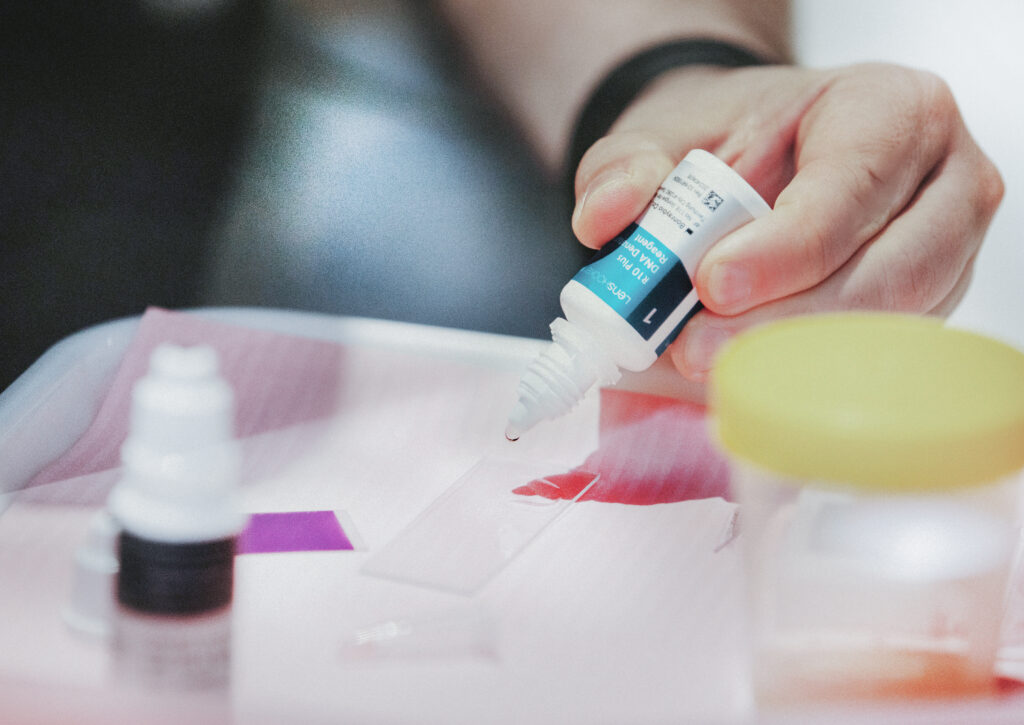
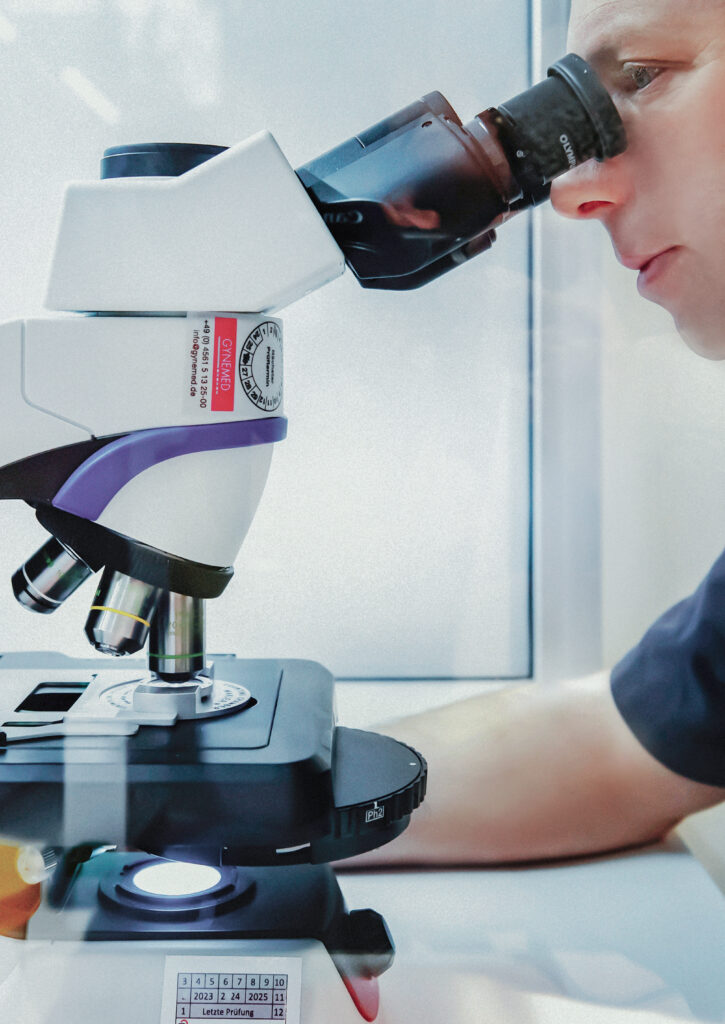
The sample is examined in our laboratory using the HaloSperm® test. This is a so-called SCD test (Sperm Chromatin Dispersion Test), which is used to determine the proportion of sperm with fragmented DNA.
-
Medical classification of the results
Our doctors classify the result together with the spermiogram, your medical history, and your previous fertility journey.
In the case of abnormal values, we will discuss possible causes and sensible further steps with you.
-
Discussion of the next steps
In the case of increased DNA fragmentation values, we will discuss possible causes with you and which further examinations or treatment options may be useful in your personal situation.
What does increased DNA fragmentation mean?
Personalised procedure
An increased proportion of sperm with fragmented DNA can impair male fertility. Increased DNA fragmentation can reduce the chances of pregnancy and a successful course of pregnancy. Fertilization and early embryonic development can also be impaired, and the risk of miscarriage may be increased. However, an increased value does not mean that a natural pregnancy is impossible.
In the case of an abnormal result, we first look for possible causes. These include, for example, a varicocele, infections or inflammation, as well as lifestyle and metabolic factors. Oxidative stress often plays an important role. Treatable or influenceable causes should therefore be addressed as specifically as possible.
Since the formation and maturation of new sperm takes several weeks, changes in sperm quality can become apparent within about two to three months. A follow-up examination may then be useful.
In the case of increased DNA fragmentation, we will discuss with you which further diagnostic examinations and targeted measures are useful in your personal situation.
What can be done about increased DNA fragmentation?
Which measures are useful depends on the cause, the extent of the DNA fragmentation, and your previous fertility history. Together with you, we will decide which next steps are sensible in your personal situation.
In the case of increased DNA fragmentation, we first check for possible treatable or influenceable causes. These include, for example, a varicocele, inflammation, or hormonal abnormalities. If necessary, we recommend a supplementary
andrological clarification. We also include lifestyle and metabolic factors in the assessment.
Since oxidative stress is often involved in DNA damage, targeted antioxidant supplementation may be useful in selected cases. After about three months, we check the DNA fragmentation again if necessary to be able to assess possible changes. The current state of research shows possible improvements, but is not consistent in all studies.
In the case of insemination (IUI) or ICSI, we can prepare and select the sperm before fertilization using special procedures. For this purpose, we use, among other things, microfluidic sperm selection with the ZyMōt® chamber.
In this process, particularly motile sperm migrate through fine microchannels and are selected particularly gently. Sperm with DNA damage are therefore significantly less common in the selected sperm population. Studies show that sperm obtained using microfluidic methods have, on average, lower DNA fragmentation.
The selected sperm can then be used for insemination, IVF, or ICSI, depending on your individual treatment.
In cases of significantly increased and repeatedly confirmed DNA fragmentation, the retrieval of sperm directly from the testicles can be considered in special situations. Testicular sperm may have lower DNA fragmentation than sperm from the ejaculate in some men.
Since this requires an invasive procedure, we do not use this method routinely for increased DNA fragmentation, but only discuss it in selected cases after careful individual consideration.

Why have the DNA fragmentation analysis performed with us in Munich
Arrange a consultation appointment-
Specialized sperm diagnostics
We examine DNA fragmentation directly in our own andrology laboratory using the HaloSperm® test (SCD test) and can combine the findings with your spermiogram and further examinations of sperm quality.
-
Personal Medical Classification
A DNA fragmentation value alone does not tell the whole story about your fertility. Our doctors assess the result together with your spermiogram, your medical history, and your previous fertility journey and discuss the findings with you personally.
-
Diagnostics and treatment from a single source
If DNA fragmentation is increased, we check possible causes and discuss specific next steps – from an andrological clarification and influenceable lifestyle factors to special sperm selection procedures such as ZyMōt® during fertility treatment.
-
Short distances in Munich
Examination, laboratory analysis, and medical advice are closely coordinated with us. Our fertility center is centrally located in Munich city center.

What Our Patients Say

Costs of DNA fragmentation tests in Munich
The costs depend on whether the DNA fragmentation analysis is carried out together with a spermiogram or as a supplementary individual examination.
To the cost overviewThe service includes a complete spermiogram as well as the supplementary analysis of sperm DNA fragmentation, including medical evaluation and reporting.
Make an appointmentIf a spermiogram from our fertility center that is no more than six weeks old is already available, the DNA fragmentation can be examined separately.
Make an appointmentNo fixed or flat-rate prices: We bill on the basis of the official scale of fees for doctors (GOÄ). According to the GOÄ, we are not allowed to quote fixed or flat-rate prices for medical services. The prices mentioned are intended to provide orientation and are typical for the treatments mentioned.
Possible VAT liability: Medical services may be subject to VAT (currently 19%). This applies if, after diagnostics have been carried out, no medical indication or confirmed diagnosis is present and it is therefore not a medical treatment in the strict sense. This can be the case in particular with social freezing treatments, but also with the treatment of single moms and same-sex couples.
We would be happy to provide you with detailed cost information for the planned treatment in advance. This allows you to clarify cost coverage with your private health insurance (PKV) as best as possible beforehand. Statutory health insurance (GKV) does not cover costs at our center.

Frequently asked questions about DNA fragmentation
What is the difference between a spermiogram and a DNA fragmentation test?
The spermiogram primarily assesses the number, motility, and shape of sperm. Damage to the sperm DNA is not visible. The DNA fragmentation test complements the spermiogram and specifically examines the quality of the sperm’s genetic material.
Can DNA fragmentation be increased despite an inconspicuous spermiogram?
Yes. Sperm can appear inconspicuous in a classic spermiogram and still have damage to their DNA. Studies show that in about 10–15% of men with an unfulfilled desire to have children, increased DNA fragmentation can be present despite an inconspicuous spermiogram. A DNA fragmentation analysis can therefore provide important additional information, especially in cases of unexplained infertility.
Can you get pregnant despite increased DNA fragmentation?
Yes. Increased DNA fragmentation does not mean that a natural pregnancy is impossible. However, it can be associated with lower chances of pregnancy, impaired embryonic development, and an increased risk of miscarriage. How relevant the finding is in an individual case always depends on the overall fertility situation.
Can increased DNA fragmentation cause miscarriages?
Increased DNA fragmentation of the sperm is associated with an increased risk of miscarriages, as paternal DNA is important for early embryonic development. However, it is only one of several possible factors. The age and egg quality of the woman as well as other medical causes also play a role.
What causes can increased DNA fragmentation have?
Possible causes include smoking, high alcohol consumption, a varicocele, infections or inflammation, advanced age, obesity, and metabolic diseases, as well as certain medications or previous chemotherapy or radiation therapy. Oxidative stress often plays an important role, and a single cause cannot always be identified.
Can increased DNA fragmentation improve?
Yes, this is possible depending on the cause. Treatable triggers such as a varicocele or inflammation can be addressed specifically. Lifestyle changes and, in selected cases, antioxidant supplementation can also be useful. Since the formation and maturation of new sperm takes several weeks, we usually reassess changes after about three months.
What can be done about increased DNA fragmentation?
We first check for possible treatable or influenceable causes. Depending on the findings, an andrological clarification, lifestyle changes, targeted supplementation, or, in the case of fertility treatment, special sperm selection procedures such as the ZyMōt® chamber may be useful. In selected cases, further reproductive medicine measures may also be considered.
Which fertility treatment is useful for increased DNA fragmentation?
Increased DNA fragmentation does not automatically mean that ICSI is necessary. If the other requirements are favorable, insemination (IUI) can also be useful. In this process, the sperm can be microfluidically selected, for example using the ZyMōt® chamber, in order to obtain a sperm population with lower DNA fragmentation.
Whether IUI, IVF, or ICSI is useful is decided individually based on the level of DNA fragmentation, the spermiogram, the previous fertility history, and the requirements of both partners. Additional sperm selection procedures can also be used for IVF or ICSI.