Laparoscopy for an unfulfilled desire to have children can be useful to identify possible causes of infertility. In particular, endometriosis or fibroids can be detected during laparoscopy. These conditions are among the most common reasons for involuntary childlessness. The benefits and risks of this procedure should be carefully weighed. At our private center “Die Kinderwunschärztin” in Munich, we provide our patients with detailed counseling before laparoscopy.
- When is laparoscopy advisable when trying to conceive?
- How does laparoscopy work?
- What you should keep in mind after laparoscopy
- Costs of laparoscopy when trying to conceive
When is laparoscopy advisable when trying to conceive?
Laparoscopy is performed primarily when adhesions, scar tissue, or endometriosis are suspected. This is because laparoscopy allows the uterus, fallopian tubes, ovaries, and other organs to be assessed very well. One advantage of laparoscopy is the ability to examine the abdominal cavity for changes that may be preventing pregnancy. In addition, minor treatments can be carried out immediately—often avoiding the need for another procedure.
In principle, laparoscopy can also be used to check whether the fallopian tubes are open. However, there are now gentler methods to assess this. For this reason, in such cases laparoscopy is only very rarely performed at our fertility center. The so-called HyCoSy procedure is usually the better alternative.
How does laparoscopy work?
A laparoscopy of the abdominal cavity always begins with a detailed consultation with our physicians. In most cases, we first perform an ultrasound examination and a physical examination to clarify whether laparoscopy is actually necessary. Although this is a very safe and well-established procedure, general anesthesia is still required. If blocked fallopian tubes are suspected, we can also assess this using the HyCoSy procedure.
The entire treatment is performed under general anesthesia, making the procedure as comfortable as possible for you as a patient. If the patency of the fallopian tubes is to be checked as part of laparoscopy, a harmless dye is introduced into the uterus. A tiny camera is then inserted into the abdominal cavity through a small incision at the level of the navel. If the fallopian tubes are open, this is indicated by the blue dye flowing out. If one or both fallopian tubes are blocked, they can usually be opened directly during laparoscopy (at least temporarily) to enable pregnancy in cases of an unfulfilled desire to have children.
If endometriosis, adhesions, or other benign conditions are suspected, the physician examines the organs in the abdominal cavity using the small camera. In this way, even very small endometriosis lesions in the woman’s body can be detected and usually removed. Ovarian cysts or fibroids are also treated.
Hysteroscopy
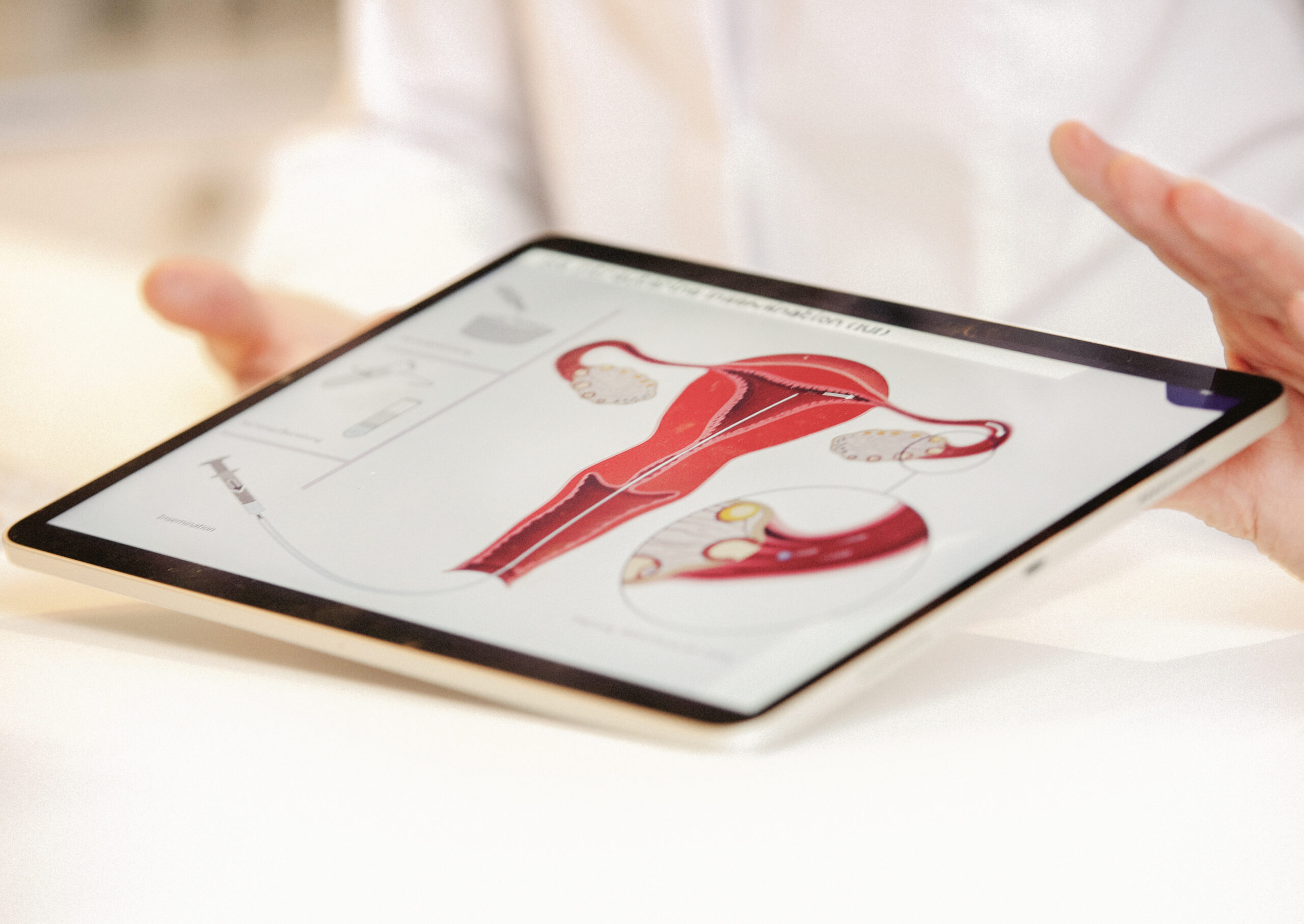
In most cases, an additional hysteroscopy is advisable. Access is usually gained through the vagina into the uterus. This allows us to reliably detect changes in the uterus, such as a polyp, and usually treat them immediately. This step is particularly useful if a previous ultrasound examination was abnormal.
Laparoscopy usually takes only 30 minutes. However, if endometriosis lesions and other changes in the woman’s abdominal cavity need to be treated during the procedure, it can take up to two hours.
Costs of laparoscopy
You will receive the exact costs of laparoscopy in the context of fertility treatment during your consultation at the private center Die Kinderwunschärztin.
What you should keep in mind after laparoscopy
Laparoscopy is usually performed on an outpatient basis. Take it easy in the days after the procedure and do not lift heavy objects. Walks in the fresh air are a good way to get your circulation going—however, you should avoid sports during the first few days.
After laparoscopy, a small scar remains in the area of the navel. On the third day after the procedure, you may shower carefully. However, be sure to cover the wound with a waterproof dressing. Foods that cause bloating can also be uncomfortable in the first few days after the examination. If you experience post-operative bleeding, fever, or severe pain, you should see a doctor immediately.